A region-specific technical and commercial guide for cosmetic packaging producers, brand managers, and plant engineers in Thailand, Vietnam, Indonesia, Malaysia, the Philippines, and Singapore exploring how injection blow molding machine technology meets the demands of Southeast Asia’s fast-growing beauty market.
Southeast Asia’s cosmetics and personal care market is one of the fastest-growing in the world. Driven by a rising middle class, rapidly expanding e-commerce penetration, and a surging appetite for both locally produced and internationally branded beauty products, the region’s demand for high-quality cosmetic packaging has grown at a pace that most packaging producers were not prepared for even five years ago. Thailand, Vietnam, and Indonesia in particular have emerged as both significant manufacturing hubs and high-growth consumer markets, creating a dual pressure on packaging producers: deliver more units, faster, with the kind of optical quality and dimensional consistency that both mass-market and premium cosmetic brands now expect as baseline.
The injection blow molding machine — specifically the one-step injection stretch blow moulding process — addresses this pressure more directly than any alternative plastic container manufacturing technology. Its integrated process eliminates the preform handling, reheating, and storage steps that slow down two-step production lines and introduce contamination and dimensional variation. Its full-servo control architecture delivers the cycle-to-cycle repeatability that high-cavity-count cosmetic tooling requires. And its multi-material capability — covering PET, PETG, PCTG, PP, PC, and Tritan on the same platform — gives Southeast Asian producers the flexibility to respond to the variety of container types, aesthetic specifications, and regulatory requirements that characterise the region’s diverse cosmetics market. This article covers the specific context: why the ISBM process is the natural fit for high-volume cosmetic packaging in this region, what machine platforms are available, what regulatory requirements apply, and what production disciplines producers need to sustain quality at scale.
The Southeast Asian Cosmetics Market: Scale, Speed, and Packaging Demand
Southeast Asia’s beauty and personal care market was valued at approximately USD 28 billion in 2024 and is projected to reach USD 42 billion by 2030, according to industry data from ASEAN packaging and consumer goods research bodies. Indonesia alone accounts for roughly 30% of the region’s personal care consumption, while Thailand, Vietnam, and the Philippines each represent significant and growing markets. What is distinctive about this region’s cosmetics growth is not just volume — it is the simultaneous growth of multiple price segments. Mass-market personal care (shampoo, body wash, lotions) is expanding through modern trade and e-commerce in rural areas as distribution infrastructure improves. Mid-market beauty (skincare serums, tinted moisturisers, hair care treatments) is growing rapidly as consumers in urban centres trade up. And premium international cosmetic brands are investing in the region’s major cities — Bangkok, Ho Chi Minh City, Kuala Lumpur, Jakarta — with packaging quality expectations that match their global standards.
For packaging producers, this means maintaining the output volume of a mass-market line while also being able to switch to premium-quality cosmetic containers with different material, different aesthetics, and different dimensional specifications without requiring a separate machine fleet. The injection blow molding machine addresses this precisely because its station architecture, servo control system, and multi-material capability allow it to run a 12-cavity shampoo bottle on one shift and a 4-cavity PETG premium serum bottle on the next, using the same machine frame with a tooling change. No other plastic container forming technology provides this range of application coverage within a single machine platform.
| Country | Primary Packaging Demand | Key Container Types | Preferred Material | Market Segment Focus |
|---|---|---|---|---|
| Thailand | High volume + premium export | Serum, lotion, body wash, toner | PETG, PET, PP | Mass + premium; export hub |
| Vietnam | Fast-growing mid-market | Shampoo, lotion, serum, eye drops | PET, PETG, PP | Domestic mass; emerging premium |
| Indonesia | Largest volume market | Body lotion, shampoo, skincare, sachet | PET, PP, PCTG | Mass market dominant; urban premium growth |
| Malaysia | Halal-certified cosmetic export | Perfume, skincare, hair care | PETG, PC, Tritan | Halal market; premium regional export |
| Philippines | Mid-market personal care growth | Lotion, whitening serum, shampoo | PET, PP | Mass to mid-market transition |
| Singapore | Premium and regional distribution hub | Luxury serum, fragrance, specialty packaging | PETG, PCTG, Tritan | Premium; APAC logistics hub |
Manufacturing Structure: Why One-Step ISBM Fits High-Volume Southeast Asian Cosmetic Production
High-volume cosmetic packaging production in Southeast Asia faces a distinct set of operating challenges that the machine architecture of one-step injection stretch blow moulding addresses better than alternative processes. Labour availability and cost are more favourable than in higher-income markets, but the shift is clearly toward automation — particularly in Thailand, Vietnam, and Malaysia where rising wages and the need for consistent quality for export markets are accelerating investment in automated production lines. Energy cost and reliability vary significantly across the region: grid reliability in industrial zones of Thailand and Malaysia is generally good, but Vietnam and Indonesia present more variable supply conditions that affect process stability. Humidity is high across most of the region for most of the year, which has specific implications for resin drying and compressed air quality that producers must actively manage.
The Integration Advantage at High Volume
The single most significant structural advantage of the injection blow molding machine for high-volume cosmetic production is the elimination of preform handling between injection and blow. In Southeast Asia’s humidity-intensive environment, PET and PETG preforms stored between production steps absorb atmospheric moisture rapidly — particularly during the wet season months when ambient relative humidity regularly exceeds 80%. This moisture absorption degrades optical clarity and barrier performance in the blown container and introduces dimensional variation from differential moisture swelling across the preform wall. On a one-step ISBM line, the preform is formed, conditioned, stretched, and blown within a single sealed machine cycle — typically 10–30 seconds from injection to finished bottle — with no exposure to ambient conditions between stations. The elimination of this moisture absorption risk is not merely a quality advantage in Southeast Asia; it is a production efficiency advantage because it eliminates a category of defect that on two-step lines is persistent, variable, and difficult to control systematically.
6-Station Architecture for Maximum Output
For producers whose primary challenge is output volume — mass-market personal care containers for Indonesia’s national brands, or export volumes for Thai contract manufacturers supplying regional and international cosmetic companies — the 6-station injection blow molding machine configuration offers a structural throughput advantage that 4-station machines cannot match. The EP-HGYS280-V6 achieves this through a twin-screw dual-injection configuration that effectively doubles the injection output per turntable cycle, with the same blowing and conditioning station architecture as equivalent 4-station platforms. For high-volume small containers — 30–250 ml personal care bottles where cosmetic brand clients require millions of units per month — the 6-station platform changes the economics of ISBM production significantly relative to running multiple 4-station machines.
Servo Architecture in Hot, Humid Operating Environments
Full servo-driven injection blow molding machines provide a specific advantage in Southeast Asia’s hot and humid operating environment: the servo drive system’s performance is less temperature-sensitive than hydraulic systems. Hydraulic oil viscosity changes with temperature — and in a plant operating at 30–38°C ambient (not unusual in equatorial Southeast Asia without full air conditioning), hydraulic actuation timing and force can drift meaningfully over a shift. Servo-electric drives maintain position and force targets regardless of ambient temperature, which means that the dimensional consistency and surface quality achieved at the start of a 12-hour shift in Indonesia’s rainy season is maintained at the end of the same shift in the dry season — a consistency that quality-conscious cosmetic brand clients require but that hydraulic-only machines often cannot sustain in tropical operating environments.
Material System: Resin Choices for Southeast Asian Cosmetic Container Applications
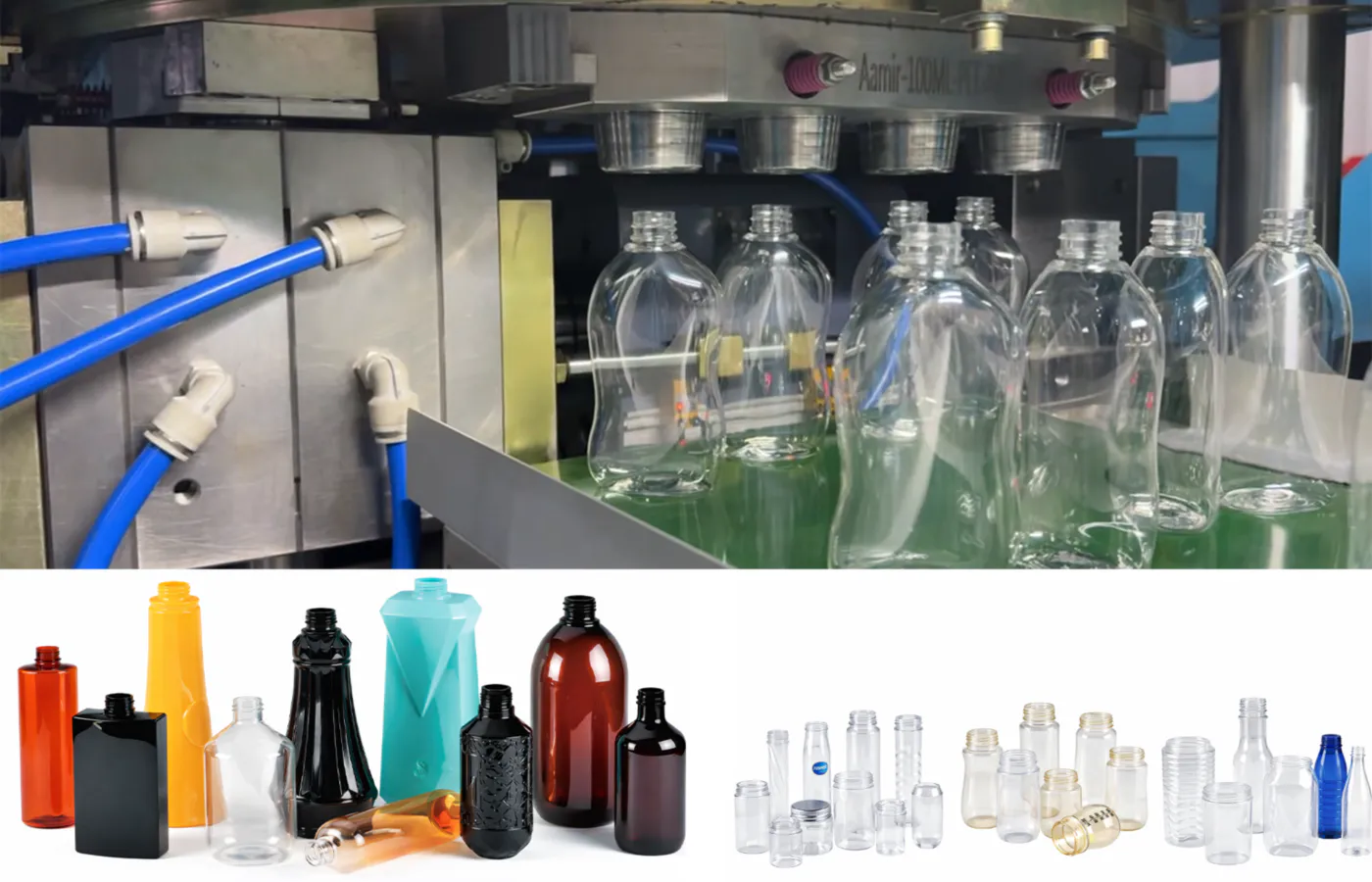
The range of cosmetic container applications across Southeast Asia’s diverse markets creates a corresponding diversity of material requirements that a single injection blow molding machine platform must accommodate. Mass-market personal care in Indonesia and the Philippines uses predominantly PET and PP for cost reasons and wide distribution channel compatibility. Premium skincare in Thailand, Malaysia, and Singapore increasingly demands PETG and PCTG for their glass-like optical properties. Halal-certified cosmetics — a significant and growing segment in Malaysia, Indonesia, and Brunei — introduce specific material compliance requirements for porcine-free processing aids and recyclable mono-material packaging. Understanding which material is right for each application is the starting point for configuring an injection stretch blow molding machine line correctly for Southeast Asian cosmetic production.
PET: The Mass-Market Workhorse
Standard PET remains the dominant material for high-volume personal care containers in Southeast Asia — body wash, shampoo, lotion, and toner bottles in the 100–500 ml range that fill modern trade shelves from Indomaret to Watson’s to 7-Eleven across the region. PET’s clarity is very good (though not matching PETG at equivalent wall thickness), its barrier properties protect alcohol- and water-based formulations effectively, and its cost per kilogram is lower than PETG or PCTG. Critically for Southeast Asian producers, PET recycling infrastructure is more developed than PETG across the region — Thailand and Malaysia in particular have established PET bottle collection and recycling programmes that support the recyclability claims that multinational cosmetic brands increasingly require from their regional packaging suppliers. Drying PET to below 50 ppm moisture in Southeast Asia’s humid ambient conditions requires well-maintained desiccant drying equipment with adequate capacity; underdrying is the primary cause of hazing on PET cosmetic containers in the region.
PETG and PCTG: The Premium Segment Standard
For premium skincare brands targeting Thailand’s growing upper-middle-class consumer base, Singapore’s luxury retail channels, and Malaysia’s halal premium cosmetics export market, PETG and PCTG are the material specifications that brand packaging designers increasingly specify. Their glass-like clarity, achievable haze values below 2%, and ability to be moulded in thick-wall geometries that create the weight and presence associated with luxury packaging make them the natural choice for the serum, essence, and treatment product categories that are driving the premium segment’s growth. PCTG’s additional chemical resistance versus PETG is relevant for formulations with higher active concentrations — an increasingly common characteristic of the functional skincare products that are expanding rapidly in the Thai and Vietnamese markets. Both materials require lower processing temperatures than PET (230–260°C melt zone versus 265–285°C for PET), reducing thermal stress on barrel components and heating elements.
PP for Opaque and Hot-Fill Applications
Polypropylene is used across Southeast Asia for personal care applications where opacity, chemical resistance, or heat tolerance are required — BB cream and foundation containers, hair colour application bottles, and thick-walled cream jars for intensive treatment products. PP’s resistance to the aromatic solvents and oxidising agents found in some hair treatment and nail care formulations makes it the safe material choice where PETG would risk stress cracking. The injection blow molding machine process handles PP well with appropriate screw geometry and conditioning station temperature management, though PP’s narrower stretch window means that the conditioning station temperature profile must be more precisely controlled than for PETG to avoid crystallisation during the thermal hold phase — which on a 4-station machine with individually controllable conditioning cores is manageable, and on a 3-station machine requires tighter process discipline.
| Material | SE Asia Application | Key Markets | Humidity Sensitivity | Recyclability (SE Asia) |
|---|---|---|---|---|
| PET | Shampoo, body wash, toner, lotion | Indonesia, Philippines, Vietnam | High (dry to <50 ppm) | Good (established streams in TH, MY) |
| PETG | Serum, essence, premium lotion | Thailand, Singapore, Malaysia | Moderate (dry to <0.02%) | Developing (varies by country) |
| PCTG | High-actives serum, halal premium | Malaysia, Singapore, export | Moderate | Limited |
| PP | Cream jars, hair colour, foundation | All markets, especially ID, PH | Low | Moderate (improving) |
| Tritan | BPA-free premium, refillable | Singapore, MY, export to EU/US | Moderate | Limited (specialty stream) |
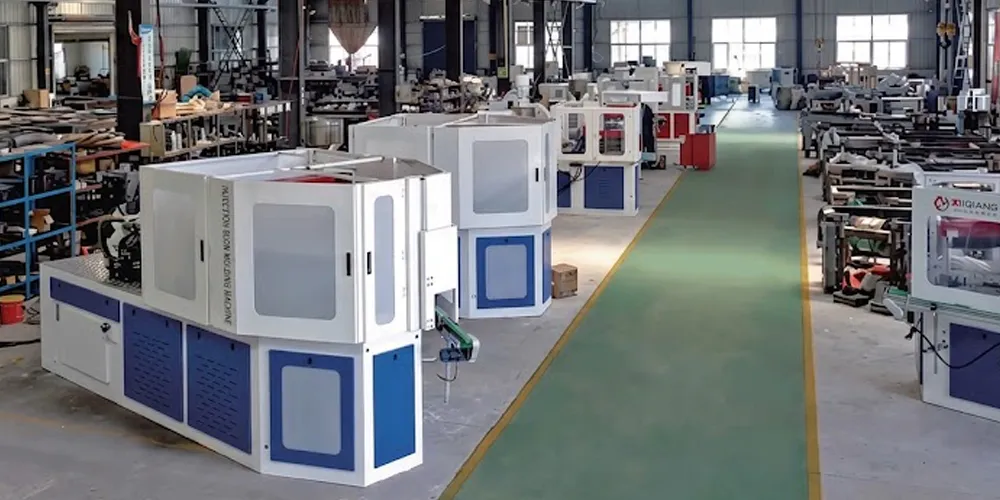
Recommended Machine Platforms for High-Volume Southeast Asian Cosmetic Production
Two injection blow molding machine platforms that address the specific production scale and application mix requirements of Southeast Asian cosmetic packaging producers — from the 6-station high-throughput configuration for mass-market volume to the proven 4-station platform for premium cosmetic applications.
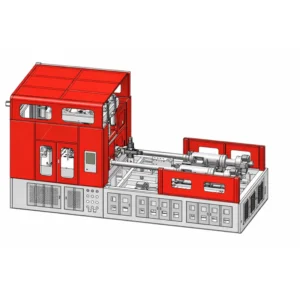
EP-HGYS280-V6 — 6-Station High-Volume
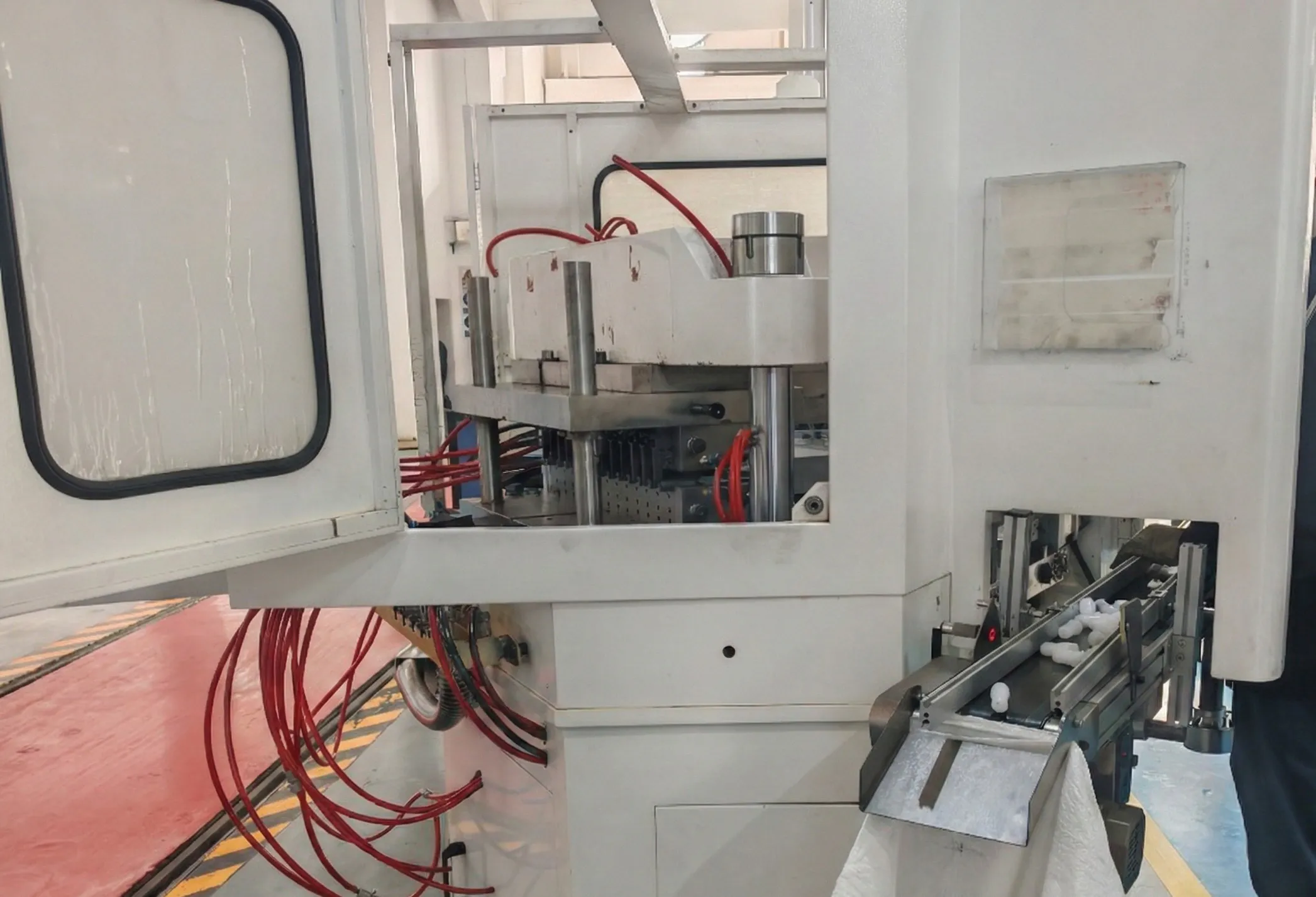
The highest-throughput platform in the ISBM range — a 6-station injection blow molding machine with twin-screw dual-injection configuration that doubles per-cycle output for high-volume small container applications. Motor power: 43.2 kW. Injection clamping force: 150 kN. Blow clamping force: 200 kN (single side). Screw diameter: 40–60 mm. Theoretical injection capacity: 188–480 cm³. Machine dimensions: 5,900 × 2,600 × 3,200 mm. Weight: 14 tonnes. Drive: 2 servo pump systems; Yaskawa / WEICHI servo turntable; Parker high-pressure valves; YUKEN hydraulic valves; Airtac cylinders; NSK lead screws; dual nano-far-infrared barrel heating (10 kW). Oil tank: 300 L. Total power: 53.2 kW. Bottle size range: 1-cavity at 120 mm diameter and 2,500 ml, up to 10-cavity at 20 mm diameter and 20 ml. For mass-market personal care producers in Thailand, Vietnam, and Indonesia running 30–250 ml container volumes at millions of units per month, this platform changes the throughput economics of one-step ISBM production relative to running multiple 4-station machines.
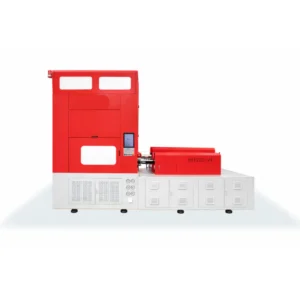
EP-HGYS200-V4 — 4-Station Premium Cosmetic
A 4-station injection blow molding machine suited for premium cosmetic containers requiring the dedicated conditioning station that delivers glass-like PETG clarity and wall uniformity for Thailand’s premium export market and Singapore’s luxury retail channels. Motor power: 49.2 kW. Injection clamping force: 300 kN. Blow clamping force: 200 kN (single side). Screw diameter: 50 mm standard. Theoretical injection capacity: 310 g. Upper mould stroke: 460 mm. Machine dimensions: 4,800 × 2,000 × 3,200 mm. Weight: 13 tonnes. ASB-12M mould compatible. Drive: servo pump; Yaskawa servo turntable; Parker valves; YUKEN hydraulic valves; Airtac cylinders; NSK lead screws; nano-far-infrared heating (10 kW). Total power: 59.2 kW. Supports PET, PETG, PCTG, PC, PP, and Tritan. The conditioning station provides zone-by-zone temperature control that eliminates pearlescence and surface cloudiness in thick-wall cosmetic containers — delivering the optical quality that Singapore’s luxury distributors and Thailand’s premium cosmetic export buyers require.
Regulatory Frameworks: What Southeast Asian and Global Standards Apply
Cosmetic packaging producers operating in Southeast Asia face a layered regulatory environment: domestic regulations in each country, ASEAN-level harmonisation frameworks, and the requirements of the export markets — primarily the EU, US, Japan, South Korea, and Australia — into which their cosmetic brand clients sell. Understanding which framework applies to each container application is not optional; it is the prerequisite for specifying materials, coatings, and documentation that avoid compliance failures at the export destination.
ASEAN Cosmetic Directive and Regional Harmonisation
The ASEAN Cosmetic Directive (ACD), implemented progressively across ASEAN member states since 2008, establishes a harmonised framework for cosmetic product regulation across the region, modelled broadly on the EU Cosmetic Regulation. Under the ACD, cosmetic packaging must not compromise product safety — establishing a base-level compatibility requirement between container material and formulation content. For packaging producers supplying cosmetic brand customers in Thailand, Vietnam, Indonesia, Malaysia, and the Philippines, material conformity documentation demonstrating that the plastic grade used meets applicable food-contact or cosmetic-contact material standards is typically required by the brand’s quality assurance team as part of supplier qualification. The injection blow molding machine process’s ability to produce single-material containers without adhesive bonding, lamination, or mixed-resin structures simplifies this compliance documentation considerably.
Thailand: FDA Thailand (อย.) and Cosmetics Act B.E. 2558
Thailand’s Food and Drug Administration (Thai FDA / อย.) regulates cosmetic products under the Cosmetics Act B.E. 2558 (2015), which requires that cosmetic packaging does not transfer harmful substances to the product. Plastic packaging for cosmetics exported from Thailand to markets including Japan, the EU, and Australia must meet the packaging material standards of the destination market — which for PETG and PET typically means migration testing under the applicable standard (EU Regulation (EU) 10/2011 for EU-bound exports; Japanese JIS standards for Japan-bound exports). Thai plastic packaging producers serving cosmetic exporters increasingly need to maintain documented material traceability and migration testing results as part of their export documentation package, particularly for premium cosmetic applications targeting Japanese and European buyers.
Indonesia: BPOM Regulation and Halal Packaging Requirements
Indonesia’s National Agency of Drug and Food Control (BPOM) regulates cosmetic products under regulations that align broadly with the ASEAN Cosmetic Directive. For packaging materials specifically, BPOM guidelines require that plastic packaging for cosmetics does not transfer harmful chemicals to the cosmetic product. Indonesia’s Law No. 33 of 2014 on Halal Product Assurance (JPH Law), implemented progressively through its implementing regulations, requires that products consumed by or applied to the body — including cosmetics — and their packaging must meet halal standards when sold under halal certification. For packaging producers supplying halal-certified cosmetic brands in Indonesia (a large and growing segment), this requires that the injection blow molding machine’s resin materials and processing aids be certified halal-compatible — specifically, that no porcine-derived additives or lubricants are used. PETG and PET without animal-derived processing aids are generally compatible with halal certification requirements, but formal certification from a BPOM-recognised halal certifying body is required for products sold under halal labelling.
Malaysia: NPB (Halal Hub), NPRA, and Sustainability Packaging
Malaysia operates a well-developed halal certification ecosystem through the Department of Islamic Development Malaysia (JAKIM), which is globally recognised and forms the basis for Malaysia’s positioning as an ASEAN halal hub. Packaging for halal-certified cosmetics exported from Malaysia must meet JAKIM’s halal packaging guidelines, which include material purity requirements. Malaysia’s National Pharmaceutical Regulatory Agency (NPRA) oversees cosmetic product notification, and its technical guidelines include requirements for packaging material safety that cosmetic packaging producers should review when supplying the Malaysian market. Malaysia’s Extended Producer Responsibility framework for packaging, in development as of 2024–2025, is expected to introduce recyclability requirements that will affect packaging material choices — a development that packaging producers should monitor as the regulations are finalised.
Vietnam: Ministry of Health Circular 06/2011/TT-BYT
Vietnam regulates cosmetic products under Ministry of Health Circular 06/2011/TT-BYT (and subsequent amendments), which implements the ASEAN Cosmetic Directive in the Vietnamese market. Plastic packaging for cosmetics in Vietnam must not cause toxicity to consumers — a provision that establishes chemical migration limits and material safety requirements. Vietnam’s packaging market is in the early stages of developing formal EPR (Extended Producer Responsibility) mechanisms; the Law on Environmental Protection (2020) and its Decree 08/2022/ND-CP establish a framework for EPR in Vietnam that is beginning to create practical obligations for packaging producers, with requirements for recyclability documentation becoming increasingly common in the quality systems of major Vietnamese cosmetic brand clients.
European Union Export: PPWR and Cosmetic Regulation
For Southeast Asian packaging producers whose cosmetic brand clients export to Europe — a significant proportion of Thailand’s and Malaysia’s cosmetic exports — the EU Packaging and Packaging Waste Regulation (PPWR, 2024–2030 implementation) creates specific packaging design requirements. Single-material PET or PETG containers from ISBM are structurally well-aligned with PPWR’s design-for-recyclability mandate. The EU Cosmetics Regulation (EC) No 1223/2009 requires that cosmetic packaging not compromise product safety, and REACH restrictions on plastic additives apply to packaging placed on the EU market regardless of the country of manufacture. Obtaining a REACH compliance declaration from the resin supplier and documenting it for EU-bound shipments is the practical compliance action for Southeast Asian packaging producers serving European cosmetic export supply chains.
| Market | Regulatory Reference | Key Packaging Material Implication |
|---|---|---|
| ASEAN (regional) | ASEAN Cosmetic Directive (ACD) | Material safety; no harmful migration to product |
| Thailand | Thai FDA; Cosmetics Act B.E. 2558 | Material traceability; migration docs for export |
| Indonesia | BPOM regulations; JPH Law (Halal) | Chemical migration; halal-compatible processing aids |
| Malaysia | JAKIM halal certification; NPRA guidelines | Halal material purity; sustainability (EPR developing) |
| Vietnam | MoH Circular 06/2011; EPR Decree 08/2022 | Material safety; emerging recyclability obligations |
| EU (export destination) | PPWR (2024–2030); EC 1223/2009; REACH | Recyclability design; REACH compliance docs |
| Japan (export destination) | Yakuji-ho (MHLW); JCIA / JIS standards | Migration testing; conformity declaration |
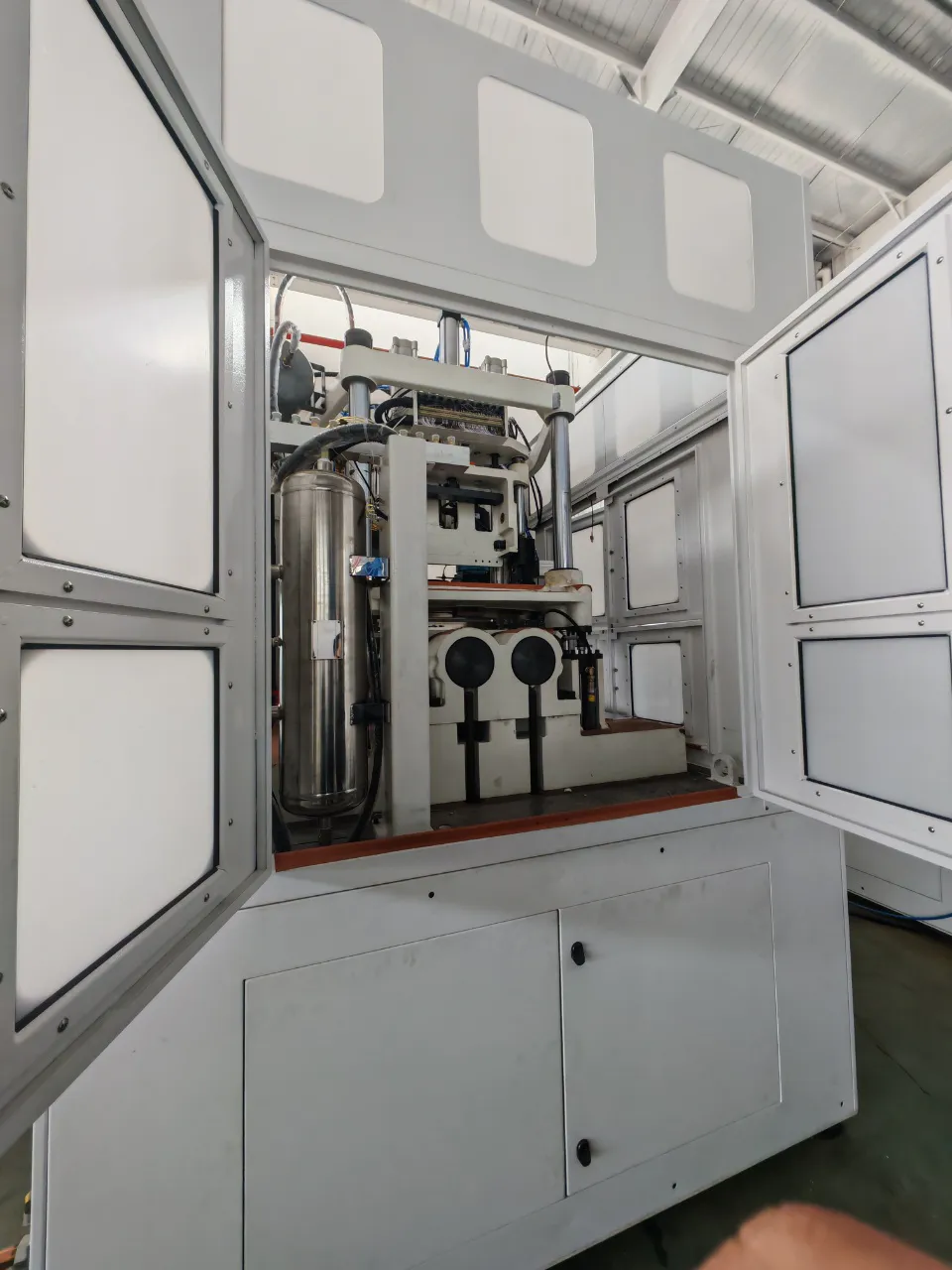
Operational Considerations for ISBM Lines in Southeast Asian Cosmetic Facilities
Running an injection blow molding machine line profitably in Southeast Asia’s cosmetic production environment requires adapting standard operating practices to the region’s specific ambient conditions, infrastructure characteristics, and workforce structure. Producers who treat ISBM as a straightforward technology transfer from European or Japanese operating manuals — without adjusting for tropical humidity, variable power supply, and the different maintenance skill base available locally — tend to underperform relative to the machine’s capability, while those who build region-specific process disciplines achieve the throughput and quality outcomes the technology makes possible.
Humidity Management: The Highest-Priority Regional Adjustment
In Malaysia, Indonesia, and Vietnam, ambient relative humidity regularly exceeds 80% during monsoon months — and in coastal or riverside industrial zones, it may exceed 90%. PET and PETG are hygroscopic materials that absorb moisture from ambient air within hours of being removed from sealed packaging. Resin that absorbs moisture before entering the dryer will take longer to dry to specification; resin that is dried correctly but held in an open hopper or transferred through unenclosed equipment will re-absorb moisture before reaching the barrel. The practical requirements for Southeast Asian operation are: sealed resin storage in conditioned environments, desiccant dryers sized for the full production shift volume rather than just the initial charge, dew-point monitoring at the dryer outlet rather than time-based drying estimates, and enclosed feed systems from dryer to machine hopper. These requirements exist in all ISBM applications but are more critical in Southeast Asia than in temperate-climate markets because the ambient moisture load against which the drying system must work is higher.
Power Supply Quality and Machine Protection
Voltage fluctuations and brief power interruptions are more common in some Southeast Asian industrial zones than in European or Japanese manufacturing environments. Servo drive units — the most sensitive electronic components on a modern injection blow molding machine — are vulnerable to voltage spikes and under-voltage events that fall within the range of what the local grid sometimes delivers. Installing voltage stabilisers and uninterruptible power supplies (UPS) for the servo drive and PLC circuits is standard practice for injection blow molding machine installations in Vietnam and some Indonesian industrial zones. Even in Thailand and Malaysia, where grid quality is generally better, surge protection for servo drive cabinets is a worthwhile investment given the capital value of the servo components relative to the cost of protection.
Maintenance Skill Development and Spare Parts Localisation
The skills required to maintain a full-servo injection blow molding machine — servo drive diagnostics, PLC troubleshooting, precision mechanical calibration of turntable index position and mould clamping force — are more specialised than for hydraulic machines, and the availability of technicians with these skills varies significantly across the region. Thailand and Malaysia have relatively well-developed industrial maintenance skill bases, including technicians familiar with Japanese servo and control systems. Vietnam and Indonesia have a growing skills base but more variable access to servo-trained technicians in locations outside major industrial cities. The practical recommendation is to budget for comprehensive commissioning training — including hands-on parameter setting, preventive maintenance, and first-level fault diagnosis — and to establish a local spare parts inventory for the highest-consumption items (seals, heating elements, thermocouples, check rings) before the machine goes into production. Relying on expedited international shipments for consumable parts creates unnecessary downtime risk in a region where import lead times and customs clearance can add 3–6 weeks to parts procurement.
Related Equipment: Auxiliary Systems for Southeast Asian Cosmetic Production
The quality and consistency of cosmetic containers produced by an injection blow molding machine in Southeast Asia depends not only on the machine itself but on the auxiliary equipment that supplies and conditions the inputs the machine needs. Two auxiliary systems are particularly critical in the Southeast Asian operating environment: compressed air supply and mold temperature control — both of which must be specified with the region’s climate and infrastructure characteristics in mind.
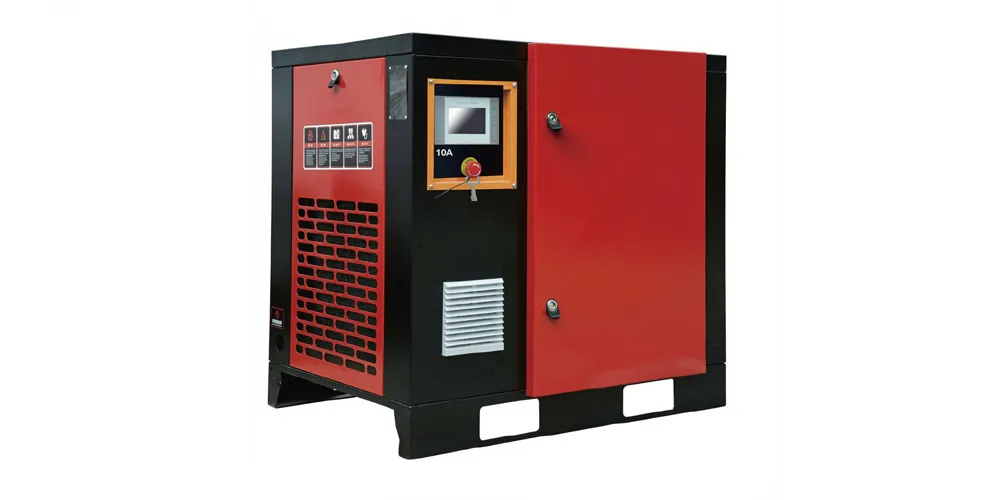
Oil-Free Air Compressor
In Southeast Asia’s high-humidity environment, compressed air supply quality for injection blow molding machine lines faces two compounding challenges: the ambient moisture load that degrades air quality if the cold-dry filter and desiccant aftercooler are not properly maintained, and the contamination risk from oil-lubricated compressors that deposit hydrocarbon residues in the blow air stream. For cosmetic containers — particularly those for skin-contact formulations where contamination is a regulatory issue under Thai FDA, BPOM, and destination-market standards — an oil-free air compressor eliminates the oil contamination pathway entirely. In halal-certified cosmetic production (Indonesia, Malaysia), the use of oil-free blow air also simplifies halal compliance by removing one potential source of non-halal contamination from the process chain. Specifying an oil-free compressor with cold-dry filtration and a dew point of −40°C or lower at the machine blow air inlet is the baseline standard for cosmetic-grade ISBM production in the region.
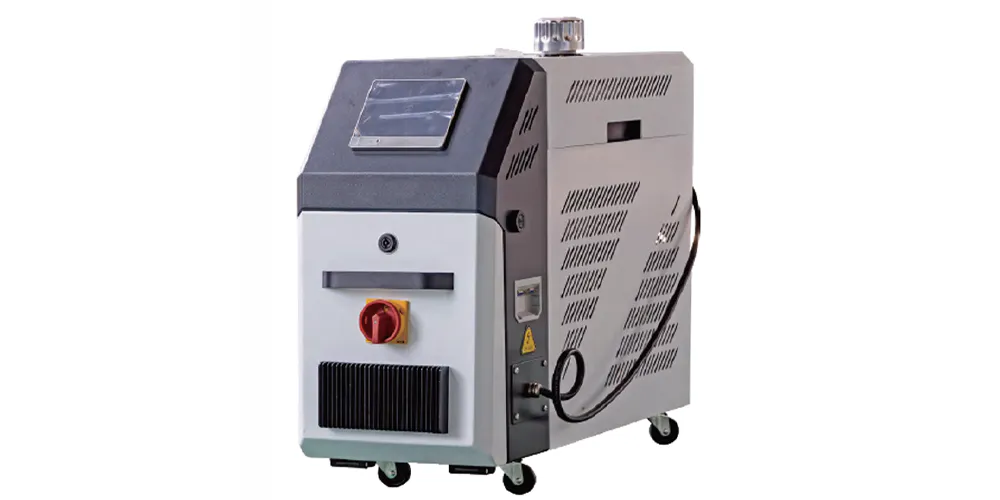
Mold Temperature Controller
Mold temperature stability is a surface quality variable that is particularly difficult to manage in Southeast Asia without a dedicated mold temperature controller, because facility cooling water temperature follows seasonal ambient temperature cycles. In Thailand, the temperature difference between the cool season (November–February) and the hot season (March–May) can produce a facility cooling water temperature swing of 8–12°C. In Indonesia and Vietnam, the wet and dry season temperature differential has a comparable effect. Each degree of mold temperature variation produces measurable changes in bottle surface gloss, clarity, and dimensional stability — creating batch-to-batch packaging variation that cosmetic brand clients notice when bottles from different production months appear together on-shelf. A dedicated mold temperature controller decouples the injection blow molding machine’s cooling circuit from facility water supply variation, holding the cavity face at a validated constant temperature regardless of season, time of day, or building cooling load. For premium PETG cosmetic bottles where surface gloss consistency is a brand quality standard, this investment is foundational rather than optional.
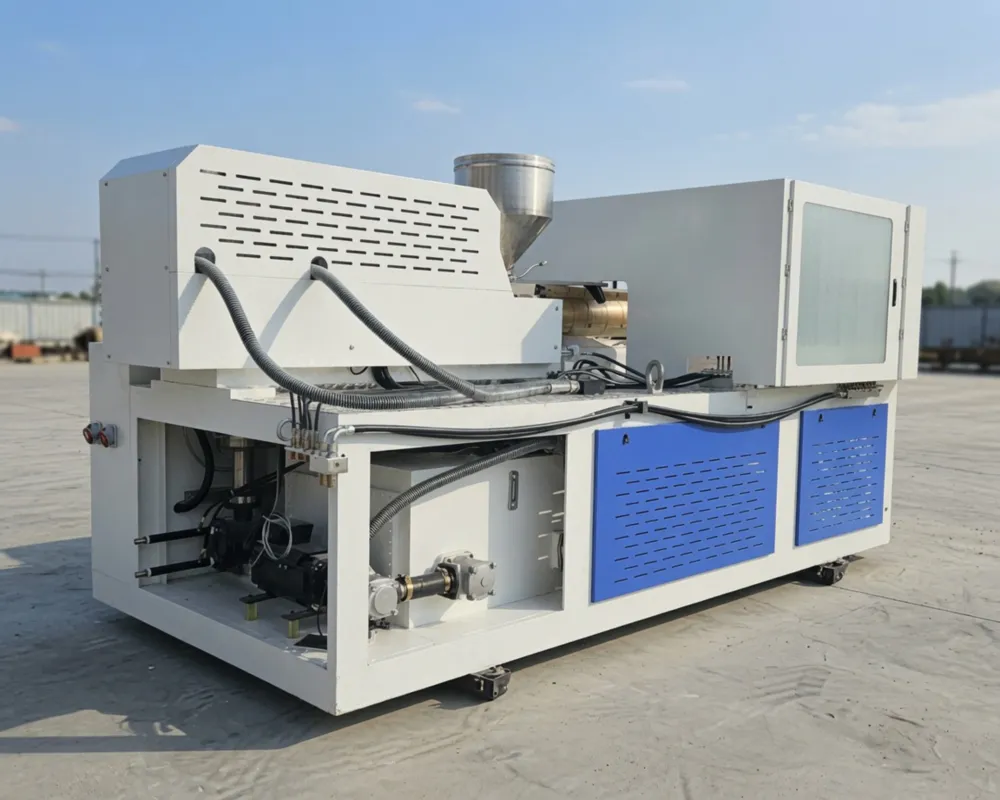
About Us
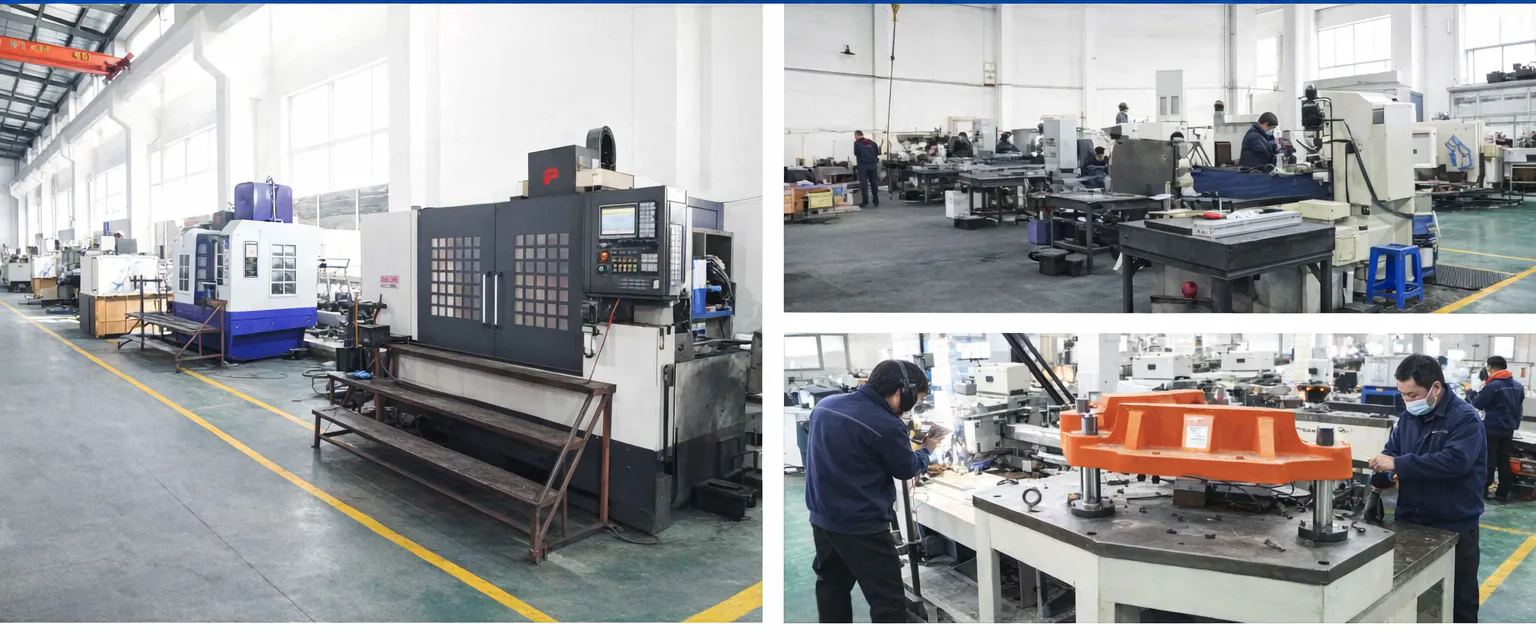
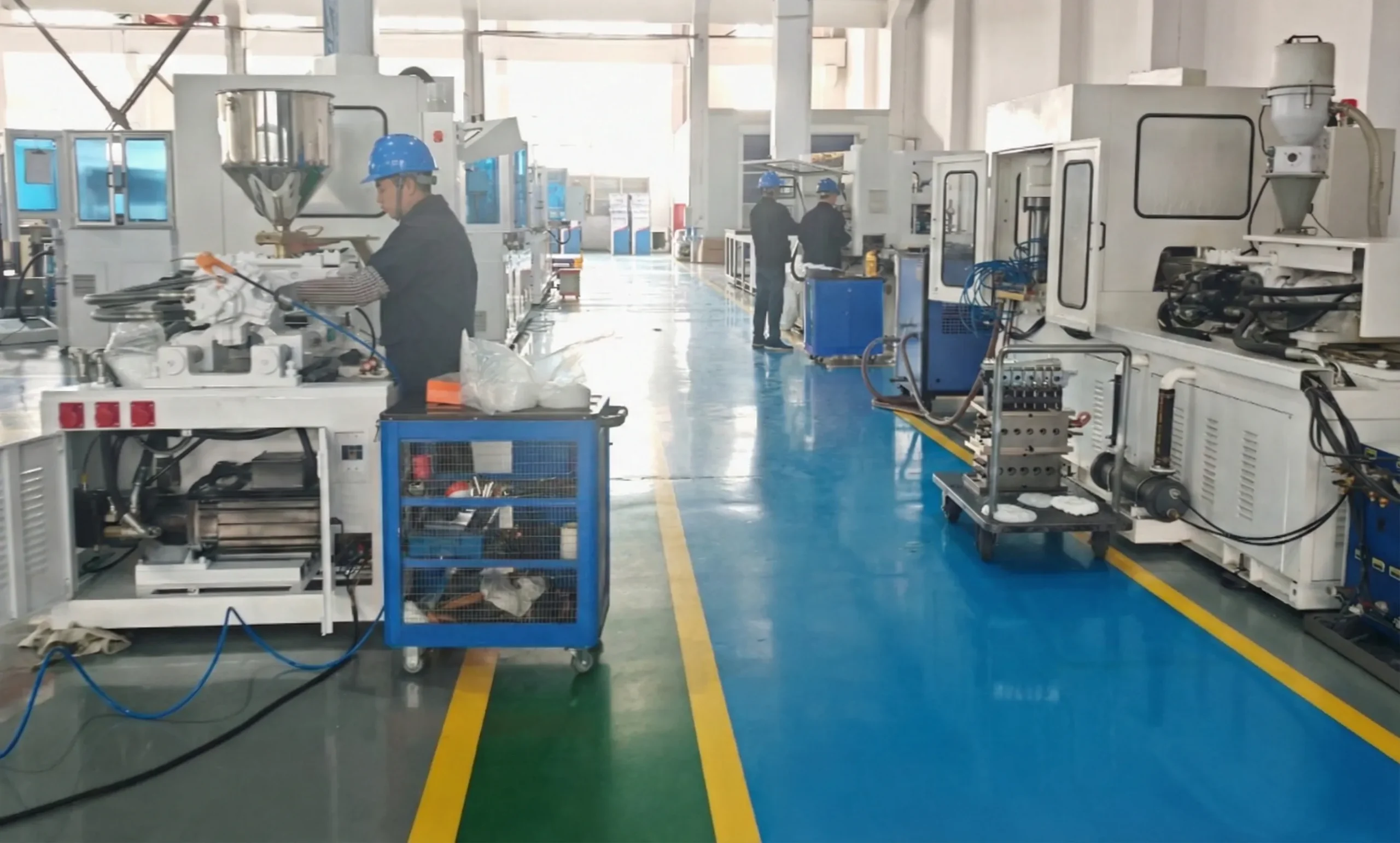
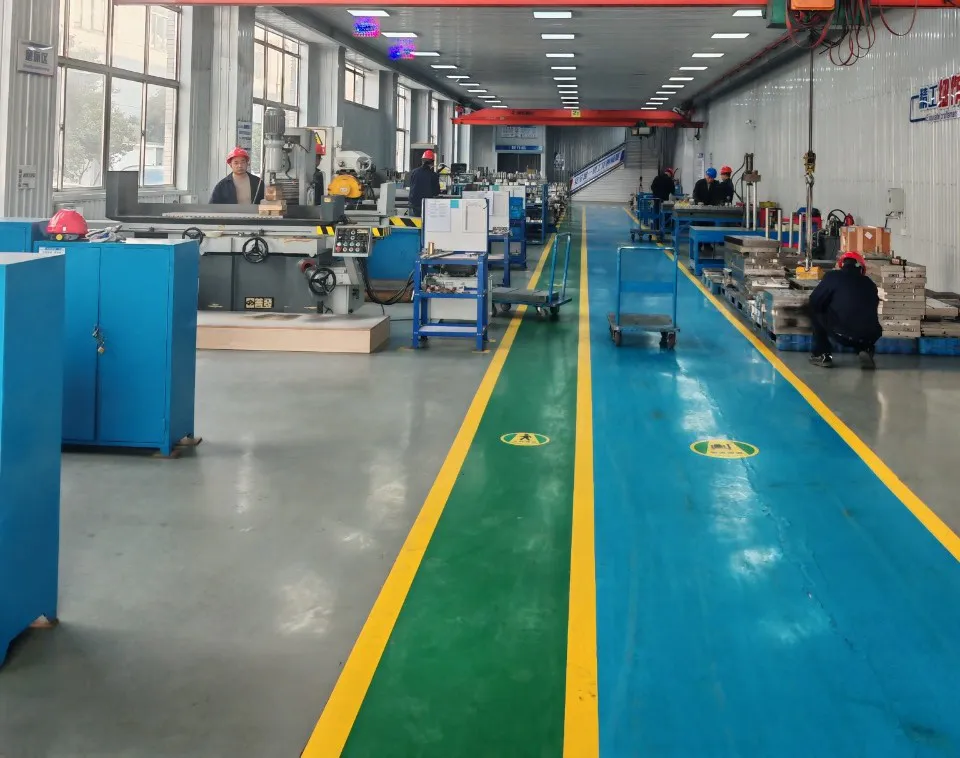
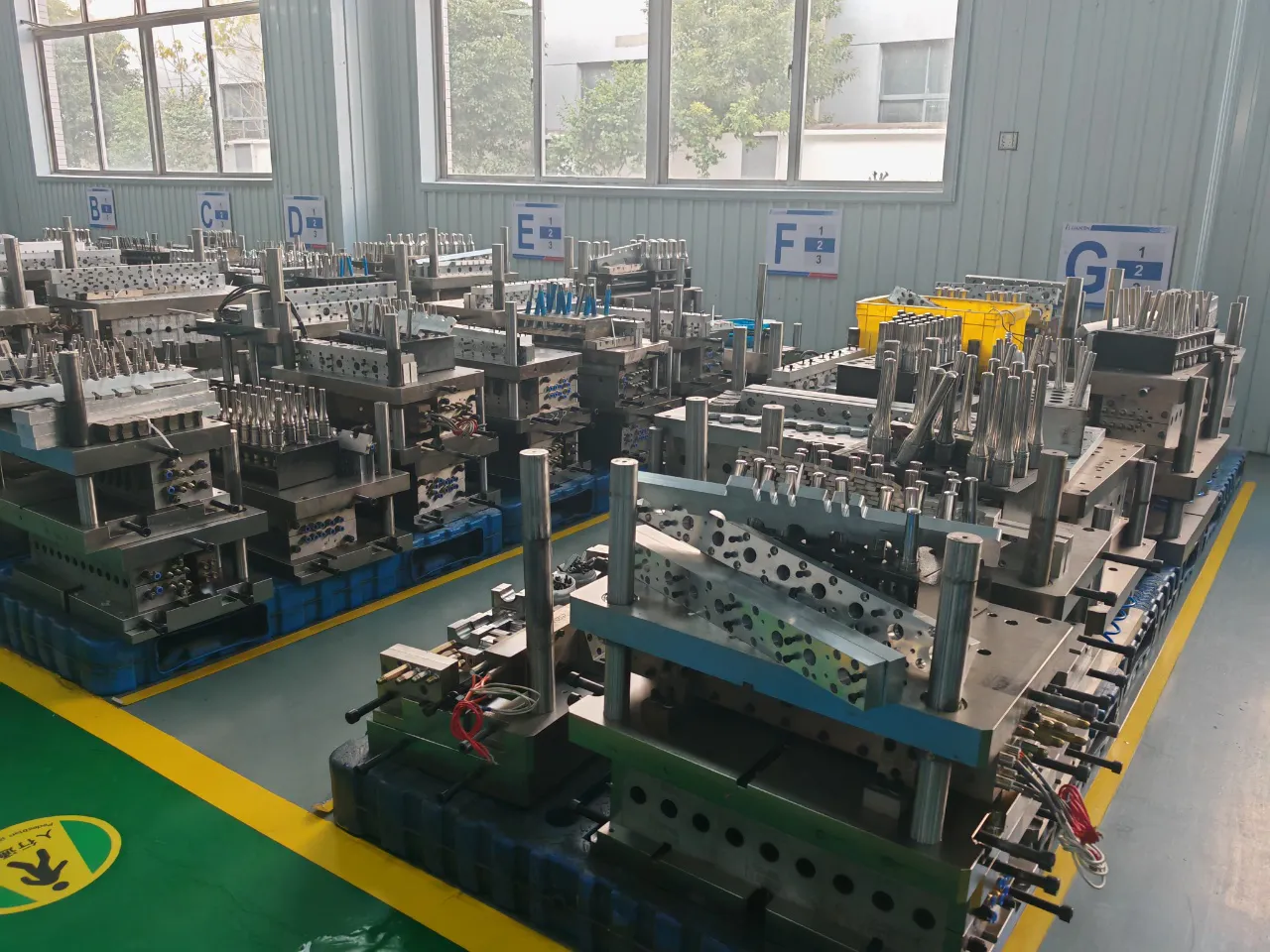
We are a professional manufacturer of one-step injection stretch blow moulding machines and mould tooling with over two decades of experience in machine development, manufacturing, and global sales. Our production facility exceeds 20,000 square metres and operates as a vertically integrated supply chain, covering machine manufacturing, in-house mould tooling production, servo system assembly, and documented spare parts support. We have developed specialised injection blow molding machine platforms for cosmetic, pharmaceutical, food, beverage, and industrial applications across PET, PETG, PCTG, PC, PP, and Tritan materials. In Southeast Asia, our machines operate in cosmetic packaging facilities across Thailand, Vietnam, Indonesia, Malaysia, and the Philippines, serving both domestic brands and international cosmetic companies producing for export. One-stop supply of machine, mould, and auxiliary equipment — with commissioning support and ongoing technical service — is a core element of how we support customers in the region.
Workshop
Frequently Asked Questions
Editor: PXY