ISBM Technical Guide — Manufacturing & Quality
A practical engineering guide for production managers, quality engineers, and packaging buyers across Colombia and Latin America who need precise, consistent wall thickness in PET and PETG containers produced on injection stretch blow moulding machines.
Why Wall Thickness Control Matters in PET Stretch Blow Molding
Container wall thickness is one of the most critical quality variables in any plastic bottle production operation. When thickness distribution is uneven — whether a bottle is too thin at the base, too heavy in the shoulder, or inconsistent between cavities — the consequences show up across every downstream step: reduced drop-test performance, failed filling-line pressure tests, unacceptable top-load strength, and unnecessary resin waste that adds direct cost to every unit produced.
The इंजेक्शन स्ट्रेच ब्लो मोल्डिंग मशीन process — commonly referred to as ISBM or one-step ISBM — has an inherent structural advantage over two-step reheat stretch blow moulding and extrusion blow moulding when it comes to wall thickness control. Because the preform is injected, temperature-conditioned, and blow-moulded in a single continuous sequence without intermediate reheating, the thermal gradient at the moment of stretch-blow is far more predictable and reproducible than in a two-step reheat system. That predictability is the starting point for tight thickness control — but it is only the starting point. Achieving consistent, specification-compliant wall thickness requires understanding and actively managing multiple machine, mould, and process variables throughout the production run.
This guide covers the complete set of factors that govern wall thickness distribution in PET and PETG bottles produced on a one-step injection stretch blow moulding machine, from the injection system through the stretch rod, the blow cavity geometry, and the machine control parameters. It also covers the inspection methods used to verify thickness compliance and the regulatory context relevant to packaging operations across Colombia and other Latin American markets.
Manufacturing Structure of the One-Step ISBM Machine and Its Impact on Thickness
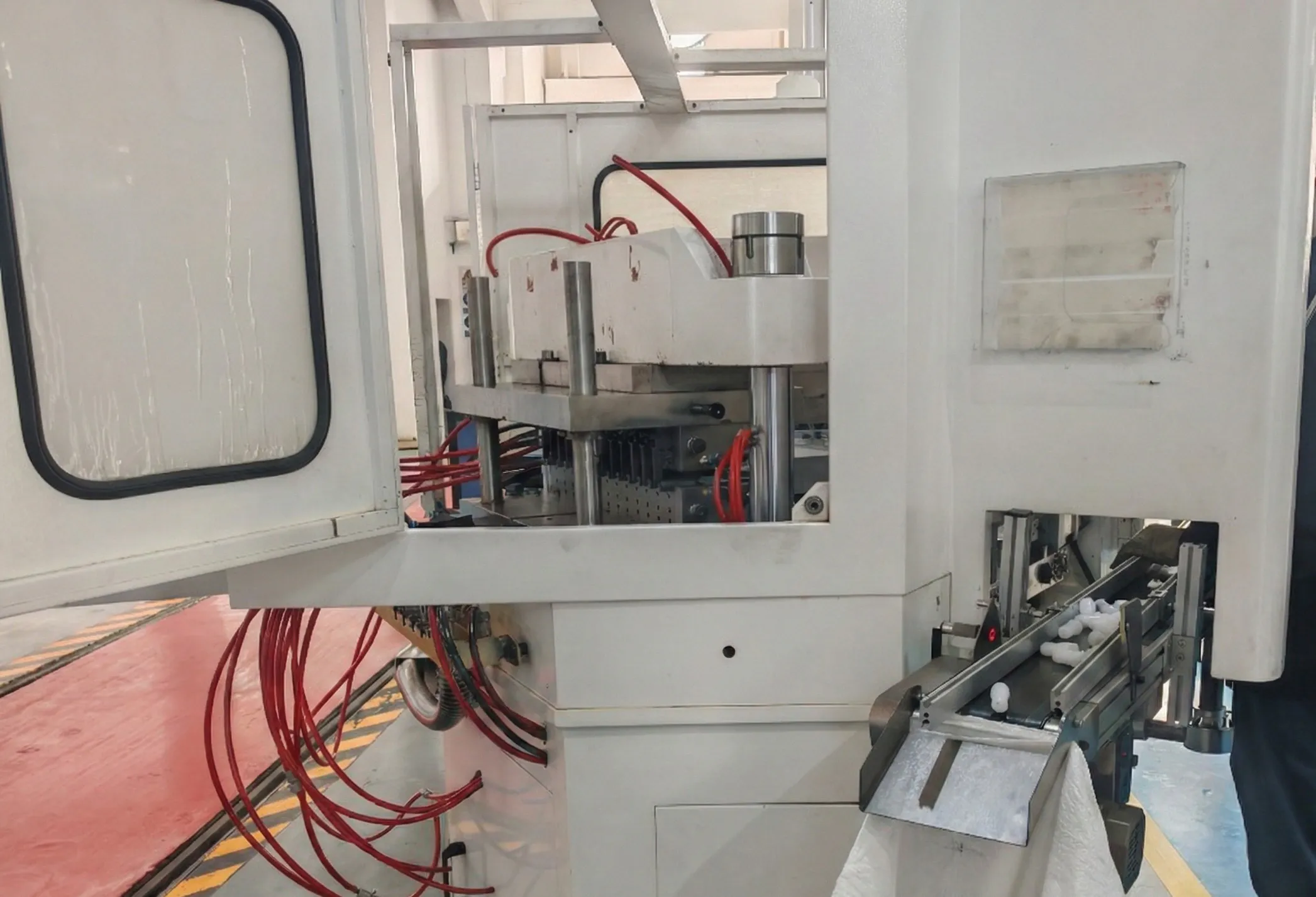
Understanding how wall thickness is determined requires a clear picture of what happens at each station in a one-step injection stretch blow moulding machine. The process moves through four main stages — injection, temperature conditioning, stretch-blow, and take-out — and each stage contributes to the final wall thickness profile of the finished bottle.
Station 1 — Preform Injection
The thickness of the finished bottle wall is first determined here, at the injection station. The preform geometry — its length, wall thickness distribution, neck finish, and base design — directly establishes where material will be available during the stretch and blow phases. A preform that is too thin in the body will produce a thin-walled container in the blow cavity regardless of how well the machine parameters are tuned. Conversely, a preform with excessive wall thickness in the shoulder zone will deliver a bottle that is too heavy and too thick in that area even with optimal process settings. The injection clamping force (ranging from 50 KN on compact machines like the HGY50-V3-EV to 400 KN on larger platforms) must be correctly set to prevent flash and maintain consistent preform geometry across all cavities.
Station 2 — Temperature Conditioning
The temperature-conditioning station — present in 4-station and 6-station configurations — adjusts the thermal profile of the preform body before it enters the blow station. In ISBM machines, the preform retains heat from injection, but the conditioning station allows fine-tuning of the axial and radial temperature gradient. A preform that is too uniform in temperature will stretch evenly but may not direct material to areas where thickness is needed, such as the base corner radius. By selectively cooling or maintaining heat in different zones, operators can bias the stretch behaviour to push more material toward the bottle base or shoulder as required by the container design.
Station 3 — Stretch-Blow Forming
At the blow station, the mechanical stretch rod elongates the preform axially while high-pressure air (operating at 2.0–3.5 MPa on most ISBM platforms) inflates it radially against the blow mould cavity. The timing of the stretch rod contact, the rod extension speed, and the air pressure sequence together determine how the preform walls thin and distribute during this phase. The blow clamping force — from 100 KN in smaller machines to 400 KN in large-capacity platforms like the HGY650-V4 — must be sufficient to hold the blow mould closed against forming pressure without deflection, which would cause thickness variation between the parting-line zone and the mould interior.
Station 4 — Take-Out and Cooling
Once the bottle is blown and the blow mould opens, the bottle is transferred to the take-out station. The wall thickness distribution is already fixed at this point, but residual heat can cause dimensional shift if the take-out station is not correctly timed. For large containers with thick base sections — such as the 5-litre and 20-litre bottles produced on the HGY650-V4 — extended blow cavity cooling time (maintained by the machine’s cooling water circuit at 0.4–0.6 MPa water pressure) is essential to prevent base deformation that can alter the effective wall thickness in the lower body zone after demoulding.
Key Process Parameters and Their Effect on Wall Thickness Distribution
The table below summarizes the principal machine parameters available to the operator of an injection stretch blow moulding machine and shows how adjusting each one specifically affects the wall thickness profile of the finished container. This reference is applicable to PET and PETG processing across the full range of one-step ISBM platforms.
| पैरामीटर | Typical Range (ISBM) | Effect When Increased | Effect When Decreased |
|---|---|---|---|
| Preform temperature (body) | 90–110°C (PET) | Material flows more freely; thinner walls, better clarity | Stiffer preform; higher orientation, higher haze risk |
| Stretch rod speed | Machine-specific (servo-controlled) | More axial orientation; thinner sidewall, thicker base | Less axial stretch; thicker sidewall, thinner base potential |
| Blow air pressure | 2.0–3.5 MPa | Better cavity replication; tighter dimensional control | Incomplete forming; thick spots where material did not reach cavity |
| Blow delay timing | 0.1–0.5 s (application dependent) | Pre-stretch allows more axial elongation before radial blow | Simultaneous stretch-blow; rounder distribution, less axial control |
| Conditioning temperature (by zone) | 80–130°C by zone | Warmer zones stretch thinner; direct thickness to cooler zones | Cooler zones resist stretching; accumulate material locally |
| Blow mould temperature | 10–25°C (water-cooled) | Warmer mould: slower set, slight sagging in vertical wall | Colder mould: fast set, prevents post-mould dimensional shift |
| Injection fill speed | Machine/mould dependent | Faster fill: thinner preform walls in gate areas, higher shear | Slower fill: heavier gate zone, risk of cold shut |
| Injection hold pressure | 60–90% of fill pressure | More material packing; heavier preform, thicker final bottle | Lighter preform; thinner bottle walls overall |
Material System — How PET and PETG Resin Properties Affect Thickness Control
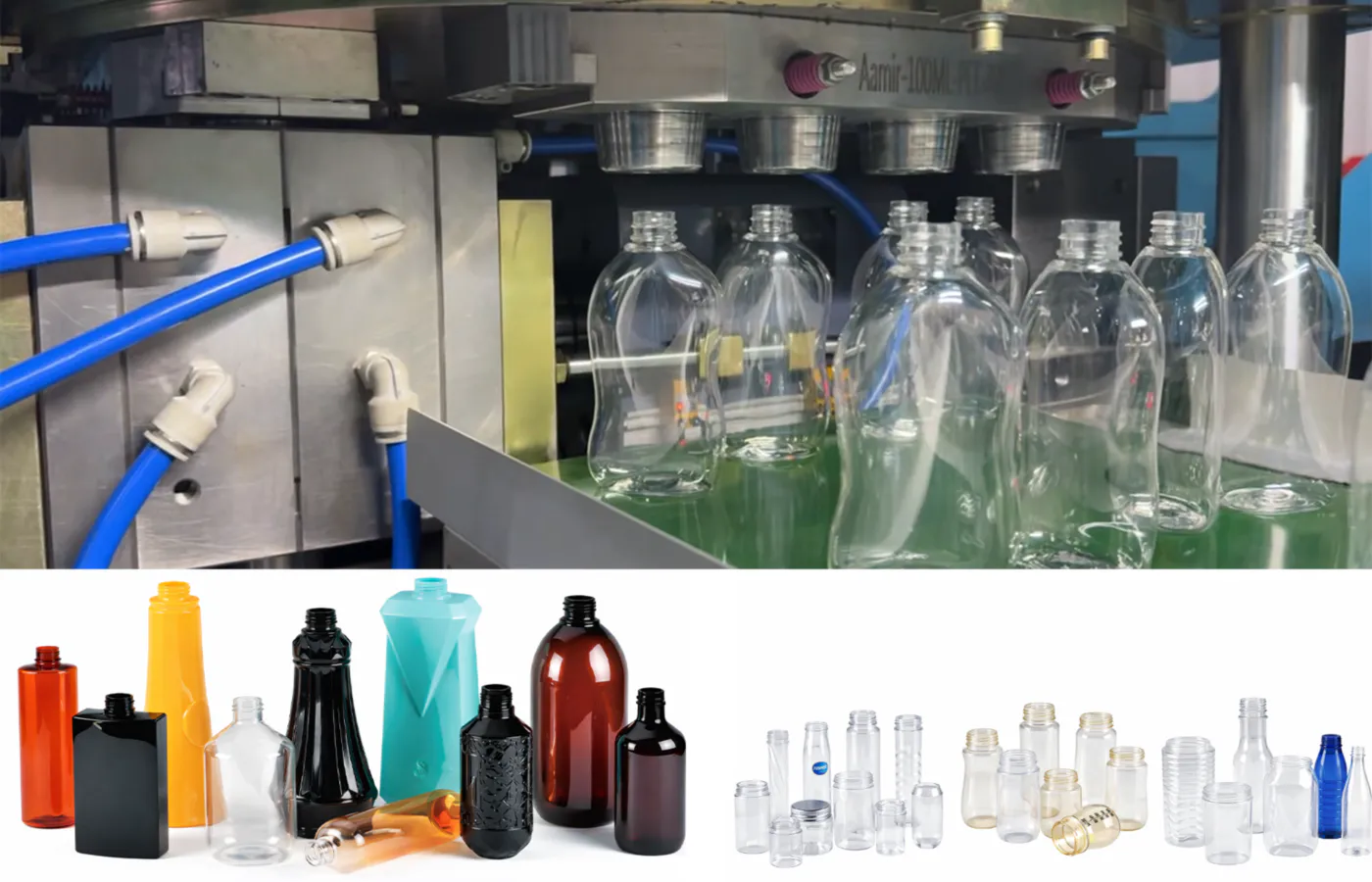
The resin grade selected for a given container application is not a neutral variable — it fundamentally determines how the material distributes during stretch blow moulding and sets the window within which the injection stretch blow moulding machine operator can make adjustments. Understanding the material system is therefore a prerequisite for effective thickness control, not an afterthought.
PET for blow moulding applications is characterized primarily by its intrinsic viscosity (IV), which is a measure of molecular chain length and determines melt flow behaviour. Standard bottle-grade PET for ISBM applications typically falls in the IV range of 0.72–0.84 dL/g. Within this range, higher IV resin produces a stronger preform with better melt strength but requires slightly higher injection temperatures to achieve equivalent flow into the mould cavity. The stretch ratio achievable before whitening or crazing depends on the IV: higher IV resin can tolerate greater stretch ratios, allowing the operator to extend the preform further axially before blow air is applied, which is key to achieving thinner, more uniform sidewalls in tall bottles.
PETG (polyethylene terephthalate glycol) behaves differently from PET during the ISBM process because it is amorphous and does not crystallize during stretch-blow. While PET develops biaxial crystallinity during stretch-blow (which gives the finished bottle its barrier properties, top-load strength, and clarity), PETG remains amorphous. This means PETG is processed at lower temperatures and the same melt distribution control techniques apply, but the self-reinforcing effect of orientation crystallization does not occur. PETG is typically used when cosmetic appearance, chemical compatibility, or design complexity requires a material that can be formed at lower blow ratios without crystallization artefacts.
For one-step ISBM machines processing PP, PC, Tritan, or ABS alongside PET/PETG — a capability available on full-servo platforms — each material requires a completely separate temperature profile, screw speed, and blow pressure setting because the crystallization behaviour, glass transition temperature, and melt viscosity differ substantially between materials. Operators in Colombia’s growing food, cosmetic, and pharmaceutical packaging sectors who run multiple resin types on a single injection stretch blow moulding machine must document and strictly enforce changeover procedures to prevent cross-contamination and off-specification wall thickness from transitional production.
पालतू
IV 0.72–0.84 dL/g. Develops orientation crystallinity during stretch. Higher stretch ratios possible. Excellent clarity and barrier. Most common resin in Colombian beverage and pharmaceutical bottle production.
पीईटीजी
Fully amorphous. No crystallization during blow. Lower processing temperatures. Ideal for complex cosmetic bottle geometries. Requires accurate temperature control to prevent deformation during demoulding.
पीपी
Higher melt temperature than PET. Suitable for hot-fill and pharmaceutical applications. Thickness control requires careful zone temperature profiling due to PP’s narrower stretch-blow window.
PC / Tritan
High transparency and impact strength. Used for baby bottles and reusable containers. Very sensitive to moisture; requires pre-drying to less than 50 ppm before injection. Thickness control strongly influenced by drying uniformity.
Preform Design and Injection Mould Quality — The Foundation of Thickness Control
No amount of process tuning on the blow station can compensate for a preform design that is fundamentally incompatible with the target bottle specification. Before any injection stretch blow moulding machine process parameters are adjusted, the preform design must be validated against the bottle drawing using a stretch ratio analysis that confirms the material available in each zone of the preform is sufficient to fill the corresponding zone of the finished bottle to the target wall thickness.
The axial stretch ratio (the ratio of the bottle body length to the preform body length) and the hoop stretch ratio (the ratio of the bottle body diameter to the preform outer diameter) together define the biaxial stretch ratio, which must typically fall between 6:1 and 9:1 for PET to achieve optimum mechanical properties. If the combined stretch ratio is below 6:1, the bottle wall will be overly thick in the body zone and underperform on top-load strength due to insufficient molecular orientation. If the ratio exceeds 9:1, the material will be stretched beyond the natural strain-hardening point and the wall will become dangerously thin, potentially leading to stress cracking or blow-through during the forming cycle.
The injection mould quality directly determines the dimensional consistency of the preform from cavity to cavity. Multi-cavity ISBM moulds — which can produce from 2 to 28 preforms per cycle depending on bottle size and machine platform — must have balanced hot runner systems that deliver identical melt temperature and flow velocity to every gate. Cavity-to-cavity weight variation above 0.5% in the preform typically translates directly to wall thickness variation in the finished bottle that exceeds the acceptable tolerance for pharmaceutical or cosmetic packaging applications in the Colombian market.
One-step injection stretch blow moulding machines are designed to use the injection mould and blow mould as an integrated system within the same machine cycle. The preform is never demoulded and reheated, which means the thermal state at the start of the blow station is far more consistent than in a two-step process. This is one of the core reasons why ISBM is preferred for precision containers in cosmetic and pharmaceutical packaging — where wall thickness tolerance of ±0.1 mm or tighter is routinely required — over reheat stretch blow moulding systems.
Typical Biaxial Stretch Ratio Guide for PET on ISBM
| Container Type | Axial SR | Hoop SR | Target Wall Thickness |
|---|---|---|---|
| Water bottle (small, <500 ml) | 2.5–3.0 | 2.8–3.5 | 0.20–0.30 mm |
| Cosmetic bottle (50–250 ml) | 2.0–2.8 | 2.5–3.2 | 0.30–0.50 mm |
| Pharmaceutical syrup bottle | 2.2–3.0 | 2.5–3.5 | 0.35–0.55 mm |
| Wide-mouth food jar | 1.5–2.2 | 2.0–2.8 | 0.40–0.80 mm |
| Large container (5–20 L) | 2.5–3.5 | 2.0–3.0 | 0.80–2.0 mm |
One-Step Injection Stretch Blow Mould Design and Its Effect on Thickness Distribution
The one-step injection stretch blow moulding mould system consists of three main tooling sets operating in concert: the injection mould (which defines the preform), the blow mould (which defines the container exterior), and the stretch rod assembly (which determines the axial stretch profile). All three must be designed and validated as a system to achieve consistent wall thickness.
In the injection mould, the gate design is critical. Gates that are too small produce high shear at the injection point, generating heat that can cause degradation and dark spots in PET, while gates that are too large leave a prominent gate mark and create a thick, difficult-to-orient gate zone. The hot runner temperature zone count — typically 4+N zones on modern ISBM injection systems — must be individually profiled to ensure that material reaching each cavity is at the same melt temperature, which is a prerequisite for cavity-to-cavity consistency.
The blow mould cavity surface finish directly affects how cleanly the material contacts and reproduces the mould geometry. A polished cavity surface (Ra 0.05–0.1 μm) produces the best wall contact during inflation, which is important for containers where external embossing or labelling surface quality is a specification requirement. The blow mould cooling channel design — the layout, diameter, and flow rate of water channels within the mould body — must be engineered to remove heat uniformly from the bottle surface after inflation. Uneven cooling creates zones where the material remains warm longer and can shift slightly before solidifying, producing a measurable wall thickness variation even if the forming step was executed correctly.
Machine Control Systems and Servo Technology for Thickness Precision
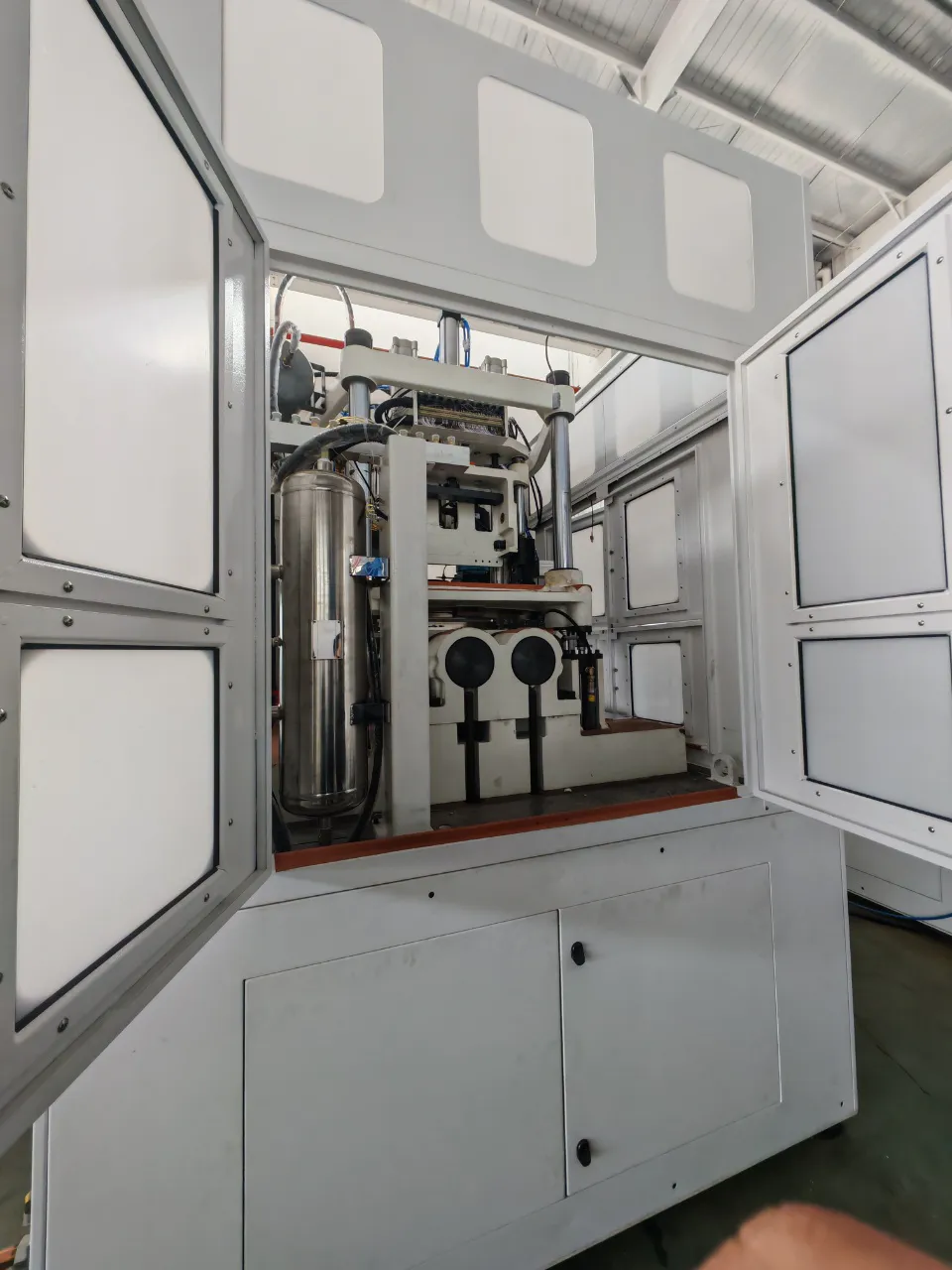
The generation of full-servo injection stretch blow moulding machines represents a significant advance in wall thickness control capability compared to hydraulic-servo hybrid machines. On a full-servo platform — such as the HGY50-V3-EV (3-station) or HGY150-V4-EV (4-station) — every motion in the machine cycle is governed by closed-loop servo motor control rather than open-loop hydraulic actuation. This has direct consequences for thickness repeatability.
The stretch rod in a full-servo ISBM machine is driven by a servo motor through a precision lead screw, allowing the rod’s position, speed, and applied force to be programmed with high resolution across the stroke profile. On a hydraulic or servo-pump machine, the stretch rod velocity is controlled by a proportional valve responding to a pressure signal, which introduces variability tied to oil temperature, pump wear, and pressure fluctuations. Over a production run of tens of thousands of cycles, the servo machine maintains a significantly tighter stretch rod velocity profile, which translates directly to more consistent axial wall thickness from bottle to bottle.
The blow air pressure control circuit is another area where servo technology improves thickness consistency. Using a Parker high-pressure valve (as specified on the platform series) with integrated pressure feedback, the machine can deliver a staged or ramped blow pressure profile rather than a single-step pressure application. A low pre-blow phase at 0.8–1.0 MPa initiates radial expansion at a controlled rate before the full 2.0–3.5 MPa forming pressure is applied. This staged approach prevents the preform from contacting the blow cavity wall prematurely in one zone before other zones are fully formed, which is a common cause of uneven sidewall thickness in tall, narrow containers.
The temperature control system — using integrated box control units with high-accuracy, stable temperature feedback — maintains the preform body temperature in the conditioning station with tight tolerances across all zones. This is particularly important for multi-cavity moulds: if the conditioning temperature is uneven across the cavity layout, the bottles at the ends of the row will have different wall thickness profiles from those at the centre. Modern ISBM machines allow individual zone temperature setting and monitoring, enabling the operator to compensate for any thermal gradient that appears across the conditioning station.
Measuring Wall Thickness — Methods and Inspection Protocols
Controlling wall thickness requires reliable measurement data. The choice of measurement method depends on the required accuracy, the production rate, and whether measurement is performed during production (online or at-line) or in a quality laboratory (offline). Three methods are commonly used in PET bottle production operations in Colombia and across Latin America.
Ultrasonic Thickness Gauge
The most common method in production environments. A handheld probe transmits a sound pulse through the bottle wall and measures the time of flight to calculate thickness. Accuracy is typically ±0.01 mm with proper calibration and coupling. Non-destructive and fast enough to sample multiple bottles per shift without removing them from the production stream. Suitable for sidewall measurements; less reliable for base measurements where geometry is complex.
Cross-Section Cutting and Micrometer
The definitive method for mapping the full thickness profile of a bottle. A bottle is cut at multiple heights and circumferential positions, and each sample is measured with a calibrated ball-tip micrometer. This provides the highest confidence in the actual thickness distribution but is destructive. Typically used during process setup, mould qualification, and during first production of a new container design. Suitable for establishing the baseline against which online inspection is calibrated.
Optical / Vision System Inspection
Automated vision systems positioned at the machine exit can detect surface defects that correlate with thickness problems — cloudiness indicating stress whitening from over-stretch, dimpling from under-blow, and visible gate marks. While not a direct thickness measurement, vision inspection at full production speed can flag out-of-specification bottles in real time and trigger an alarm before a larger quality event accumulates. Some advanced systems use near-infrared transmitted-light measurement for thickness estimation.
Sampling Frequency Recommendation:
For production operations supplying pharmaceutical or high-end cosmetic customers in Colombia — where INVIMA pharmaceutical registration or export certification to the United States may be required — a minimum sampling protocol of 5 bottles per cavity per shift is recommended for wall thickness measurement, with full cross-section analysis performed at the start of each production run and after any process interruption exceeding 30 minutes. Records must be retained for regulatory audit purposes.
Regulatory and Compliance Context for Wall Thickness in Colombian and Global Markets
Container wall thickness is not only a mechanical performance specification — in regulated industries such as pharmaceutical and food packaging, it is a compliance requirement that intersects with multiple national and international regulatory frameworks applicable to operations in Colombia, Brazil, the United States, and the European Union.
Colombia — INVIMA and NTC Standards
INVIMA (Instituto Nacional de Vigilancia de Medicamentos y Alimentos) regulates pharmaceutical and food container packaging quality in Colombia. For pharmaceutical bottles produced by injection stretch blow moulding, NTC (Norma Técnica Colombiana) standards reference ISO 15223-1 for container markings and ISO 11607 for sterile packaging integrity, where wall thickness uniformity is a material property that supports compliance. Producers supplying INVIMA-registered pharmaceutical manufacturers must document the container wall thickness specification and demonstrate process capability through statistical records.
Brazil — ANVISA and ABNT
Brazil’s ANVISA (Agência Nacional de Vigilância Sanitária) governs container specifications for pharmaceutical and food products sold in the Brazilian market. ABNT NBR standards for plastic packaging containers reference wall thickness as a functional specification for drop resistance and top-load performance. Exporters from Colombia to Brazil using ISBM-produced containers should align container specifications with ABNT NBR 14619 (containers for pharmaceutical products) and the applicable ANVISA RDC regulations covering primary packaging materials.
USA — FDA 21 CFR and ASTM Standards
FDA 21 CFR Part 177 governs the food contact status of PET resin used in container production for the US market. ASTM D2911 (Standard Specification for Plastic Bottles for Pharmaceutical Use) specifies dimensional tolerance requirements including wall thickness for pharmaceutical bottles. ASTM D4169 (Standard Practice for Performance Testing of Shipping Containers) tests that indirectly verify wall thickness adequacy through drop and compression performance. For Colombian producers exporting to the United States, compliance with these standards requires documented wall thickness data as part of the technical dossier.
EU — Regulation (EC) 10/2011 and EN Standards
The European Union’s plastic materials and articles regulation EC 10/2011 governs materials intended for food contact, including PET containers. EN 15593 covers hygiene requirements for packaging manufacturing. For pharmaceutical container applications in the EU, the European Pharmacopoeia (Ph. Eur.) container monographs specify mechanical integrity tests that are influenced by wall thickness. Producers operating or supplying to the EU market need documented process controls for wall thickness as part of the quality management system required under ISO 9001 or GMP (Good Manufacturing Practice) certification.
Troubleshooting Common Wall Thickness Problems on ISBM Machines
The following table is a practical troubleshooting reference for the most common wall thickness defects observed on one-step injection stretch blow moulding machines, organized by the observed defect and its most probable root cause and corrective action.
| Defect | Root Cause | Corrective Action |
|---|---|---|
| Base too thick, body too thin | Insufficient stretch rod travel or rod delay too long | Increase axial stretch rod stroke; reduce blow delay; check rod alignment |
| Base too thin (stress whitening) | Excessive stretch ratio; preform base wall too thin | Increase preform base thickness; reduce rod travel; increase conditioning temperature |
| Thick spot on one side of sidewall | Blow rod eccentricity; preform not centred in blow cavity | Check rod alignment; inspect blow mould alignment to injection mould; check rotary table indexing accuracy |
| Cavity-to-cavity weight variation | Hot runner temperature imbalance; gate wear variation | Audit hot runner zone temperatures; measure individual cavity gate dimensions; balance hot runner flow |
| Shoulder overly thick, body correct | Preform shoulder zone too hot; insufficient axial stretch in shoulder zone | Cool shoulder conditioning zone; adjust rod contact point; redesign preform shoulder geometry |
| Overall thin container (light weight) | Insufficient injection hold pressure; short shot in preform | Increase injection hold pressure; check injection fill profile; measure preform weight against specification |
हमारे बारे में
We are a professional manufacturer of fully automatic one-step injection stretch blow moulding machines and precision blow moulding tools, with over two decades of focused research and development in ISBM technology. Our product range spans compact three-station full-servo platforms up to large-capacity four-station and six-station systems capable of producing containers from 1 ml to 20 litres across PET, PETG, PP, PC, Tritan, PS, ABS, and PLA resins.
Our machines have supported packaging operations for cosmetics, pharmaceutical, beverage, food, and specialty chemical applications in Colombia, Peru, Mexico, Chile, Brazil, and across Latin America. Every machine in our series is engineered with the servo control precision, temperature management accuracy, and blow pressure stability that direct wall thickness control in ISBM production requires. We offer pre-sale process consultation, on-site commissioning, and comprehensive after-sale technical support to ensure customers achieve the wall thickness targets their applications demand.
Our injection stretch blow moulding machine platforms are compatible with ASB and AOKI mould formats, enabling customers to leverage existing mould investments while upgrading machine control capabilities. If you are evaluating machine options or troubleshooting an existing process in Colombia or elsewhere in Latin America, our technical team is ready to provide qualified guidance.
कार्यशाला
अक्सर पूछे जाने वाले प्रश्नों
संपादक: पीएक्सवाई