
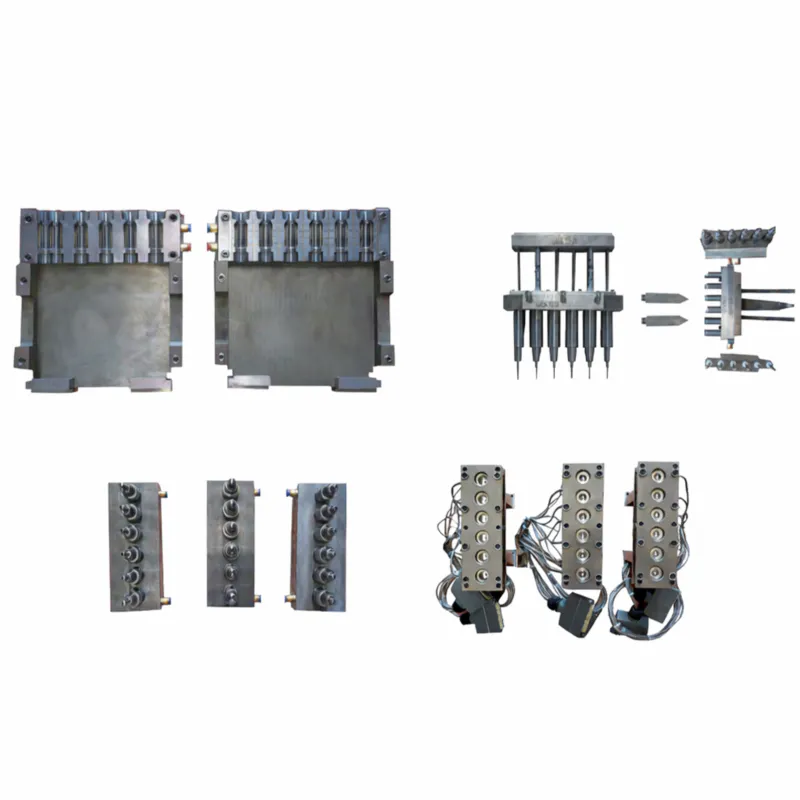
قالب نفخ بالحقن والتمديد بخطوة واحدة من EP
The EP One-step Injection Stretch Blowing Mould is a precision tooling set covering the complete production sequence on one-step ISBM machines — from preform injection through temperature conditioning to stretch-blow forming and container ejection. Available in configurations from 1 up to 12 cavities per cycle, these mould sets support container volumes from 20 ml up to 5,000 ml and are built to serve small specialty runs as well as sustained high-volume commercial packaging operations. Every set is precision-machined in matched components to guarantee dimensional consistency, uniform wall thickness, and reproducible container quality from first production shot onward.
1. Advantages of our ISBM machine and its molds
ال One-step Injection Stretch Blowing Mould is not a single tool in isolation — it is a complete, matched mould system comprising the injection preform mould, the blow mould cavity set, the stretch rod assembly, and where the machine platform requires it, the temperature conditioning core set. All components are engineered and calibrated together so that the preform geometry created at the injection station feeds directly and predictably into the blow station. This integration defines one-step ISBM tooling and is why container dimensions, neck finish accuracy, and wall thickness uniformity consistently surpass what two-stage reheat systems typically achieve in real production environments. Our factory brings together over two decades of accumulated tooling design and manufacturing experience, having supplied mould sets to customers running cosmetic, pharmaceutical, food, and beverage packaging lines across multiple continents — including an expanding base of industrial buyers in Colombia and Latin America.
Compatibility is a primary design criterion across the entire injection stretch blow moulding mould range. Standard configurations are purpose-built for our BPET-70V4, BPET-94V3, and BPET-125V4 machine series. We also manufacture replacement mould sets dimensionally compatible with Japanese ASB-12M and AOKI-250 type machines — a practical solution for customers operating legacy equipment who want to upgrade tooling without replacing the machine itself. Custom cavity designs, unique neck finish geometries, and non-standard container shapes are handled through our mould engineering department, which is equipped with CNC machining centers and EDM equipment to work from customer-supplied 3D files or physical bottle samples.
Quality at the steel selection and heat-treatment stage is what separates long-running production tooling from tooling that requires premature repair. Injection cavity inserts are machined from pre-hardened P20 or H13 tool steel with cavity surfaces polished to mirror finish, ensuring the optical clarity that premium cosmetic and pharmaceutical containers demand. Blow mould halves are manufactured from aviation-grade aluminum alloy with hard anodizing, selected for its thermal conductivity, light weight for rapid mould changes, and adequate hardness for high-cycle operation. Mould bases are stress-relieved before final machining to eliminate residual stress that would cause dimensional drift over extended production. The result is a tooling program that genuinely serves the injection stretch blow molding products that buyers in competitive markets need to produce consistently and profitably.

2. How the One-step Injection Stretch Blowing Mould Works
Understanding how the mould system functions within the overall عملية التشكيل بالنفخ والتمديد بالحقن clarifies why tooling precision is so critical to production outcomes. On a 3-station machine the cycle runs as follows: at Station 1 the injection mould closes around the hot-runner gate, molten resin is injected to form the preform, and the neck finish is dimensionally set here with tolerances typically tighter than ±0.05 mm — every thread pitch, sealing surface, and tamper-evident geometry established in this single station. The preform is carried on the neck cores to Station 2 where it is tail-trimmed or thermally conditioned, and from there to Station 3 where the blow mould closes around it. A stretch rod descends axially, elongating the preform while radial blow pressure simultaneously expands the wall against the cavity surface to achieve the container shape. On 4-station machines the additional conditioning station between injection and blow allows more precise temperature equilibration, which is why 4-station configurations can reliably handle thick-walled or wide-mouth containers that would challenge a 3-station layout.
The finished bottle performance — clarity, wall thickness uniformity, top-load strength, and barrier performance — traces back directly to the mould design. Cavity surface roughness determines optical clarity; cooling channel layout determines cycle time and crystallinity; preform wall thickness profile determines how material distributes during biaxial stretching. A well-engineered injection stretch blow mold is therefore not just a shaping tool but a precision process component. Our mould engineering team models material flow, stretch distribution, and cooling behavior before committing to steel cutting — so the physical mould performs as predicted from the first trial shot rather than after multiple rounds of expensive rework.
3. Five Key Product Advantages
Each One-step Injection Stretch Blowing Mould is delivered as a dimensionally validated matched set — injection mould, blow mould, stretch rod assembly, and conditioning core — machined to work together without field shimming or post-delivery adjustment. This eliminates the preform-to-blow alignment drift that is the most common cause of wall thickness variation and off-center bases in ISBM production. For customers in Colombia and Latin America operating high-mix bottle lines, receiving a pre-validated matched set dramatically reduces changeover time when switching between product SKUs.
Our mould sets serve as a practical, cost-effective replacement of ASB and AOKI tooling without requiring machine modification. Dimensional interfaces — platen mounting pattern, neck core pitch, blow cavity parting-line geometry — are matched to original machine specifications. Factories already running Japanese equipment gain access to competitively priced replacement mould options with the same dimensional interchangeability, enabling production continuity while significantly reducing tooling procurement costs compared to sourcing OEM parts from original machine builders.
Injection cavity inserts are machined from H13 or P20 pre-hardened tool steel at 48–52 HRC, then polished to Ra ≤ 0.05 μm for premium optical clarity. Blow mould halves are produced from 7075 aviation aluminum with hard-anodized surfaces combining thermal efficiency with scratch resistance. S136 stainless neck rings are precision ground to ±0.01 mm on the sealing diameter. This material and finish program ensures that container surface quality and neck finish dimensional capability are maintained through millions of production cycles without progressive cavity degradation.
From a single-cavity prototype mould to a 12-cavity high-output production tool, our injection blow moulding mould range scales to match machine capacity and production demand. The modular cavity insert design means that for certain neck finish and container families, the same mould base can be reconfigured with different cavity inserts when product specifications change — reducing the tooling investment required when a packaging brand updates its container design. Single-row and dual-row configurations are available for machines that support parallel preform alignment layouts.
Each mould set is designed for the specific material the customer intends to run — PET, PETG, PETE, high-transparency PP, PCTG, SAN, PC, PMMA, PS, or TRITAN (BPA-free). Gate geometry, runner balance, cavity venting, and cooling layout are all optimized at the design stage for the nominated resin type. This flexibility means a single mould program can serve needs from standard PET water bottles through medical-grade PC pharmaceutical containers and BPA-free baby product bottles, all within one manufacturing technology platform without process compromise.
4. Mould Materials & Construction Standards
The longevity and output quality of any injection stretch blow moulding mould are determined first at the material selection stage. Inferior steel, inadequate heat treatment, or imprecise machining tolerances cause premature cavity wear, flash at the parting line, and inconsistent preform dimensions long before the mould reaches its intended service life. Our mould construction standards address every critical material and process parameter in the tooling supply chain, from raw steel procurement through final dimensional inspection before dispatch.
Injection cavity inserts are machined from H13 hot-work tool steel (equivalent to DIN 1.2344) or P20 pre-hardened steel (DIN 1.2311) depending on production volume and resin type. H13 is selected for high-volume runs and engineering resins such as PC and PPSU that impose high injection pressure and elevated mould temperatures; P20 is appropriate for cosmetic PET and PETG applications at moderate pressures. Both steels undergo vacuum heat treatment and double tempering for uniform hardness. Blow mould halves in 7075-T6 aviation aluminum offer thermal conductivity approximately five times greater than steel, translating directly to shorter cooling time per cycle and improved crystallinity control in the container wall. Neck rings and core pins defining thread and sealing geometry are produced from hardened S136 stainless steel (similar to AISI 420 modified) for corrosion resistance against moisture and polymer decomposition gases. Stretch rods are ground from through-hardened stainless steel bar to ±0.01 mm dimensional tolerance with surface roughness Ra ≤ 0.2 μm to minimize friction during axial preform penetration.
| Mould Component | مادة | Hardness | Surface Finish | Key Notes |
|---|---|---|---|---|
| Injection Cavity Insert | H13 / P20 Tool Steel | 48–52 HRC (H13) / 28–34 HRC (P20) | Mirror polish Ra ≤ 0.05 μm | Vacuum heat treated, double tempered |
| Blow Mould Cavity | 7075-T6 Aluminum Alloy | HB 150–175 | Hard anodizing 25–30 μm | High thermal conductivity, fast cycle cooling |
| Neck Ring / Thread Core | S136 Stainless Steel | 50–52 HRC | High-gloss polish | Corrosion-resistant, ground ±0.01 mm sealing diameter |
| Stretch Rod | Hardened Stainless Steel | 52–55 HRC | Ground Ra ≤ 0.2 μm | Dimensional tolerance ±0.01 mm |
| Mould Base / Frame | 45# Steel (stress-relieved) | HRC 28–34 | Black oxide / nickel plate | CNC-machined after stress relief annealing |
| Conditioning Core | Beryllium Copper / H13 | HRC 36–40 | Polished | High thermal conductivity for uniform temperature regulation |

5. Machine Model and Number of Mould Cavity Specifications
The tables below list the maximum container dimensions achievable at each cavity count for the three primary machine models. These figures represent the design envelope within which custom container profiles can be developed. Actual dimensions for a specific bottle depend on the stretch ratio, material, and wall thickness target. Our mould engineers review every custom design against these limits before committing to tooling fabrication, ensuring the container specification is achievable on the nominated machine platform before any steel is cut.
EP-BPET-70V4 — Mould Cavity Dimensions
| Parameter | وحدة | 1 Cavity | 2 Cavities | 3 Cavities | 4 Cavities | 5 Cavities | 6 Cavities |
|---|---|---|---|---|---|---|---|
| Max. External Neck | مم | 80 | 60 | 45 | 34 | 30 | 20 |
| Max. Body Diameter | مم | 116 | 99 | 75 | 66 | 50 | 44 |
| أقصى ارتفاع | مم | 300 | 300 | 300 | 200 | 200 | 200 |
| أقصى حجم | مل | 2,500 | 2,300 | 1,000 | 500 | 300 | 150 |
EP-BPET-125V4 — Mould Cavity Dimensions
| Parameter | وحدة | 1 | 2 | 3 | 4 | 5 | 6 | 7 | 8 | 9 | 10 | 11 | 12 |
|---|---|---|---|---|---|---|---|---|---|---|---|---|---|
| Max. External Neck (mm) | مم | 148 | 120 | 99 | 94 | 73 | 57 | 42 | 36 | 34 | 26 | 23 | 18 |
| Max. Body Diameter (mm) | مم | 204 | 152 | 130 | 120 | 98 | 78 | 66 | 54 | 53 | 44 | 40 | 37 |
| Max. Height (mm) | مم | 300 | 300 | 300 | 300 | 300 | 250 | 250 | 250 | 250 | 250 | 250 | 250 |
| Max. Volume (ml) | مل | 5,000 | 3,000 | 2,000 | 1,000 | 800 | 600 | 450 | 400 | 300 | 250 | 200 | 100 |
EP-BPET-94V3 — Mould Cavity Dimensions
| Parameter | وحدة | 1 | 2 | 3 | 4 | 5 | 6 | 7 | 8 |
|---|---|---|---|---|---|---|---|---|---|
| Max. External Neck (mm) | مم | 110 | 109 | 89 | 70 | 42 | 34 | 30 | 24 |
| Max. Body Diameter (mm) | مم | 149 | 130 | 130 | 100 | 80 | 66 | 54 | 48 |
| Max. Height (mm) | مم | 300 | 300 | 300 | 300 | 250 | 250 | 200 | 200 |
| Max. Volume (ml) | مل | 4,500 | 2,500 | 2,500 | 1,500 | 800 | 500 | 300 | 200 |
ماكينة حقن وتشكيل بالنفخ والتمديد EP-BPET-94-V3 | 3 محطات

6. Application Scenarios
تعدد استخدامات One-step Injection Stretch Blowing Mould makes it the tooling of choice across a wide spectrum of packaging sectors. The application areas below represent the primary commercial uses for these mould sets in production environments operating in Colombia, Latin America, and internationally.
Cosmetic & Personal Care Packaging
Premium serum bottles, lotion containers, shampoo vessels, and foundation packaging require the highest optical clarity and sharpest neck finish precision the injection stretch blow molding process can deliver. Mirror-polished H13 injection cavities and S136 neck cores in our mould sets deliver the visual quality and dimensional repeatability that brand-owner specifications demand. PETG and PCTG formulations that enhance color depth and impact resistance are fully supported with material-specific gate and cooling design.
Pharmaceutical & Medical Packaging
Eye drop bottles, syrup containers, tablet jars, and infusion bottles require contamination-free production and rigorous dimensional control at the neck finish to guarantee closure leak-tightness. The sealed, single-machine one-step process eliminates intermediate preform handling, the primary contamination risk in two-stage systems. PC and PPSU materials for reusable medical containers are accommodated with appropriately specified cavity steel, gate design, and processing temperature documentation for pharmaceutical regulatory submissions.
حاويات الطعام والمشروبات
PET water bottles, juice containers, condiment bottles, and food-grade wide-mouth jars are among the highest-volume applications for one-step ISBM tooling. Our mould design achieves the biaxial molecular orientation necessary for adequate top-load strength and barrier performance in food-grade PET. Wide-mouth jar configurations up to 204 mm body diameter are available on the BPET-125V4 platform with adjusted cavity count, enabling production of food containers that would not be achievable on smaller-format machines.
Baby & Infant Product Bottles
Baby bottles and sippy cups require BPA-free materials — TRITAN, PPSU, or food-grade PC — combined with extremely precise neck finish dimensions to ensure compatibility with standard feeding nipple closures. Our baby product mould tooling is designed with particular attention to gate vestige minimization: the container interior must be smooth, cleanable, and free of any material stubs that could harbor bacteria. Documentation supporting BPA-free compliance and food safety certification is provided with every baby product mould set.
Household & Industrial Chemical Containers
PETG and PP formulations for household cleaning products, automotive fluids, and agricultural chemicals place demanding requirements on chemical resistance and on the precision of neck finish sealing zones where child-resistant closures engage. Our PP-optimized mould sets incorporate specifically tuned hot runner temperature profiles and cavity venting to handle the flow characteristics of semi-crystalline polypropylene — a material that behaves significantly differently from PET in the one-step ISBM process and requires dedicated tooling engineering rather than adaptation of standard PET tooling.
Craft, Special-Shape, and LED Components
The one-step ISBM process uniquely enables consistent production of non-rotationally-symmetric containers — square bottles, oval sections, triangular profiles, and custom embossed shapes — that are difficult to achieve reliably on two-stage systems due to preform-to-blow alignment complexity. LED lampshade components and decorative craft containers produced from PS or PMMA are among the specialty applications served by our custom-profiled injection stretch blow mold tooling, where the mould engineering team works from customer-supplied geometry files or physical samples.
7. Regulatory & Industry Standards for ISBM Plastic Packaging
Buyers of injection blow moulding tooling and the plastic containers produced with it operate within a complex regulatory environment covering food contact safety, pharmaceutical packaging compliance, environmental policy, and industrial safety. The overview below covers key applicable standards across major markets relevant to our customers, with particular attention to Colombia and the Latin American region where regulatory awareness is increasingly important for packaging suppliers and brand owners alike.
| Jurisdiction | Standard / Regulation | Relevance to ISBM Packaging |
|---|---|---|
| Colombia | INVIMA Resolución 683/2012 (food contact NTC) | Regulates plastics in contact with food; PET, PETG, PP containers require material declaration and migration testing under ICONTEC NTC standards |
| Colombia | Ley 1672 de 2013 / Ley 1466 de 2011 plastic waste | Promotes recyclable mono-material packaging; PET containers produced by ISBM are fully recyclable, supporting compliance with extended producer responsibility requirements |
| Colombia | Decreto 1596 de 2015 / RETIE | Electrical safety and machinery guarding requirements apply to ISBM machines and ancillary equipment operating in Colombian facilities |
| European Union | Regulation (EC) No 1935/2004 – Food Contact Materials | Governs all materials in contact with food; requires supplier documentation and traceability for all plastic components including PET ISBM containers for food or beverage use |
| European Union | EU Regulation 10/2011 – Plastic Food Contact Materials | Specific migration limits for plastic additives; overall migration limit ≤ 10 mg/dm² applies to PET and PP resins used in ISBM; mould suppliers must ensure cavity materials do not introduce contamination |
| USA | FDA 21 CFR Part 177 – Indirect Food Additives: Polymers | Standards for resins in food packaging including PET (177.1630) and PP (177.1520); relevant when ISBM containers are exported to or used in the United States market |
| Brazil | ANVISA RDC 327/2019 – Plastic Packaging | Brazil's health regulatory authority mandates approval of food-contact plastics; ISBM containers exported to Brazil must use ANVISA-listed resins with conformity documentation |
| Pharmaceutical Global | ICH Q8 / USP <661> Plastic Pharmaceutical Packaging | Defines extractables and leachables testing for pharmaceutical containers; ISBM pharmaceutical mould tooling minimizes gate vestige and internal surface roughness to reduce extraction risk |
| International | ISO 9001:2015 – Quality Management System | Increasingly required from mould suppliers as a qualification prerequisite by multinational packaged goods manufacturers |
| International | ISO 15750 / ISO 22000 (Food Safety Management) | Food safety management system standards; mould tooling quality documentation supports customer ISO 22000 certification audits at food and beverage packaging factories |
8. About Us
We have established a robust supply chain that guarantees machine stability, energy efficiency, and a comprehensive one-stop service for our global partners. Our professional service team consists of industry veterans who provide end-to-end support, from mold design and prototype sampling to on-site installation and staff training. For the Latin American market, particularly Colombia, we understand the importance of cost-effectiveness without compromising on precision. Our machine is a great replacement for ASB injection stretch blow molding machines and other Japanese brands, offering comparable performance at approximately 35% of the capital expenditure, coupled with faster lead times and localized technical support.
ورشة عمل
9. Related Products & System Components
In addition to One-step Injection Stretch Blowing Mould sets and ISBM machines, we offer a broader range of precision mechanical components and drive system products that support complete packaging line construction and ongoing maintenance. Our one-stop supply capability reduces procurement complexity for customers building or upgrading production lines across Colombia and the wider Latin American market.
Rigid Couplings & Shaft Components
Precision mechanical couplings for connecting drive shafts on packaging and conveyor equipment require the same dimensional accuracy standards as mould tooling. We supply rigid and flexible coupling products compatible with the drive configurations common on ISBM machines and downstream filling and labeling lines. Explore our Rigid Coupling range
Gearboxes & Speed Reducers
Drive gearboxes and precision speed reducers are integral to the conveyor systems, rotary table drives, and auxiliary handling equipment surrounding ISBM production lines. We maintain supply capabilities for high-performance gearbox products that complement our mould and machine offerings, supporting customers who need a single source for both tooling and mechanical drive components. View our Gearbox catalogue

الأسئلة الشائعة
المحرر: PXY
