1. Process Mechanics: Action Mode, Structural Type, and Manufacturing Architecture
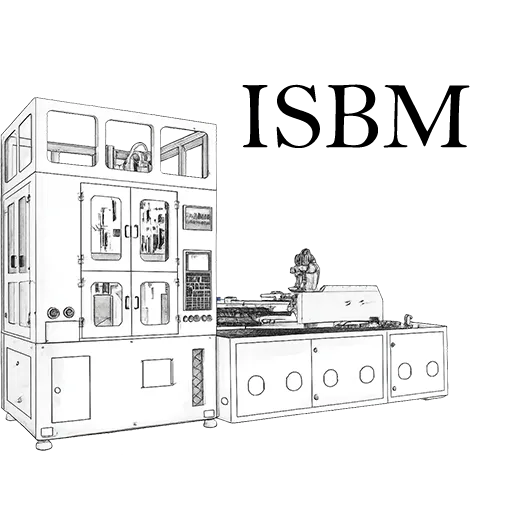
Action Mode — Rotary Multi-Station Operation: The injection stretch blow molding process operates through a rotary indexing platform that simultaneously processes containers at multiple work stations in a single machine cycle. In a four-station configuration — the most common layout in commercial production — Station 1 performs injection moulding of the preform, Station 2 manages heat preservation and preform tail cutting or pre-blowing conditioning, Station 3 executes biaxial stretch blow moulding, and Station 4 handles container ejection and take-out. All four stations operate in parallel, so each machine cycle produces finished containers while simultaneously injecting the next preform batch. This concurrent operation maximizes output per unit time without the dead time inherent in sequential processing, giving the injection stretch blow moulding machine a throughput advantage that grows as container counts per station increase.
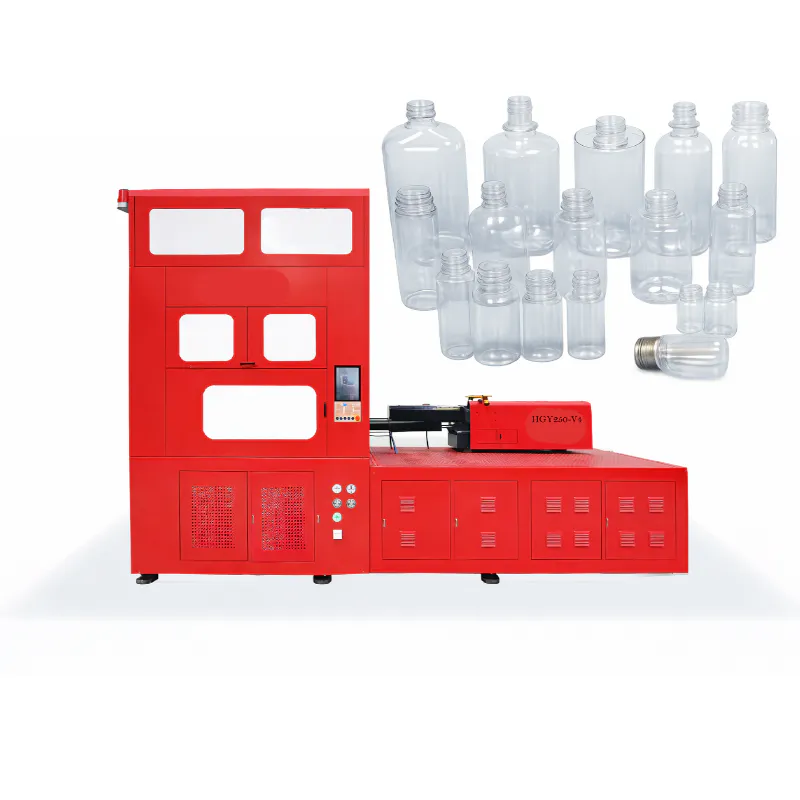
Structural Type — Servo-Driven vs. Hydraulic vs. Fully Electric: The injection stretch blow molding machine market currently offers three primary drive architecture categories. Standard hydraulic models use hydraulic cylinders for clamping and injection, providing high clamping force at competitive purchase cost but with higher energy consumption and oil contamination risk. Servo-hydraulic models replace fixed-displacement hydraulic pumps with variable-displacement servo pump systems, reducing energy consumption by thirty to forty percent while maintaining the force capability of hydraulic designs. Fully electric models, designated EV in some product lines, eliminate hydraulic oil entirely by using servo motors for all motion axes including injection, clamping, and mould opening — the preferred choice for pharmaceutical, food contact, and baby product applications where oil contamination of the container interior is categorically unacceptable. The machine series available spans configurations from compact three-station units suitable for laboratory or specialty production to large six-station twin-screw models processing twenty-four cavities simultaneously for high-volume beverage and commodity applications.
Manufacturing Structure — Key Subsystems: The injection unit comprises screw diameter options typically ranging from 40 mm to 60 mm, with theoretical injection volumes from approximately 188 cm³ to 480 cm³ depending on configuration. Injection clamping force ranges from 50 kN in compact three-station models to 400 kN in large-format machines handling containers up to twenty litres capacity. Blow moulding clamping force ranges from 100 kN single-side in entry models to 400 kN single-side in large machines. The blow air pressure system typically operates between 2.0 and 3.5 MPa high pressure with 1.0 MPa low pressure for machine motion circuits. Temperature control employs integrated control boxes with high-accuracy zone management, and the screw barrel heating system uses nano far-infrared energy-saving heating rings for improved thermal efficiency.
2. Material System: Compatible Polymers and Surface Treatment
Material System: The injection stretch blow molding machine’s material versatility is one of its core competitive advantages over two-step systems. The injection unit can process any thermoplastic with suitable melt viscosity and crystallization behavior, while the stretch blow station benefits from polymers that respond well to biaxial orientation. Primary materials include PET (polyethylene terephthalate) and PETG for beverage, cosmetic, and pharmaceutical containers; PP (polypropylene) for food-safe and heat-resistant applications; PC (polycarbonate) for impact-resistant baby bottles and outdoor products; PPSU (polyphenylsulfone) for high-performance baby feeding bottles requiring repeated steam sterilization; Tritan (copolyester) for BPA-free food and drinkware; PCTG for transparent wide-mouth containers; PS (polystyrene) for cosmetic packaging; ABS for opaque technical containers; and PLA (polylactic acid) for biodegradable container production aligning with environmental sustainability programs. Each material requires specific screw design, temperature profile, and stretch ratio parameters that modern control systems manage through recipe-based production programs.
Surface Treatment — Mould Technology: Mould tooling for the one-step injection stretch blow moulding machine uses S136 stainless steel for the injection cavity and blow mould components, providing both the dimensional stability needed for high-precision containers and the chemical resistance to withstand the thermal cycling and process materials in long production runs. The injection mould hot runner system uses high-precision valve gates that ensure gate vestige elimination, critical for pharmaceutical and cosmetic containers where gate marks affect both appearance and filling equipment compatibility. Mould compatibility extends to established platforms including ASB-12M, Aoki-250, and ASB-70DPH geometries, allowing users to transfer existing mould tooling assets to newer machine platforms without incurring complete mould replacement costs.
3. Five Key Advantages That Drive Industrial Adoption of Injection Stretch Blow Moulding Machines
Energy Efficiency Through Preform Heat Retention
The single most cited advantage of the one-step injection stretch blow molding machine is its elimination of the preform reheating stage required in two-step processes. Because the preform travels directly from the injection station to the stretch blow station while retaining residual injection heat, the energy input required for stretch blow moulding is reduced to a conditioning function rather than a full reheating cycle. Independent energy consumption studies consistently show energy savings of thirty-five to forty percent compared to equivalent two-step production of the same container. For Colombian manufacturers facing rising electricity costs and sustainability reporting requirements, this energy advantage translates directly to lower per-unit production cost and reduced carbon intensity of the finished container.
Superior Container Quality and Batch Consistency
Biaxial molecular orientation during the stretch blow phase significantly improves container wall strength, barrier properties against gas and moisture permeation, and transparency. Because the preform geometry directly determines the final container wall thickness distribution, the precision of injection moulding translates into highly consistent container weights and dimensions across every cavity in the mould. This batch-to-batch consistency is particularly valued in pharmaceutical packaging, where container dimensional variation directly affects filling equipment performance, and in cosmetics, where visual uniformity across shelf displays is a marketing requirement that purchasing managers enforce through incoming quality inspection.
Compact Footprint with Reduced Labor Requirements
A single injection stretch blow moulding machine replacing the combined preform injection machine, preform cooling conveyor, preform warehouse, preform transport, and blow moulding machine of a two-step line reduces factory floor space requirements dramatically. Typical four-station machines occupy between fourteen and thirty-eight square meters floor area depending on capacity. The self-contained process requires one operator per shift for routine monitoring and quality sampling, compared to multiple operators required across the distributed workstations of a two-step production line. For Colombia’s manufacturing sector where both factory space in industrial parks and skilled technical labor are constrained resources, this labor and space efficiency directly affects the investment return calculation.
Flexible Production Across Multiple Container Formats
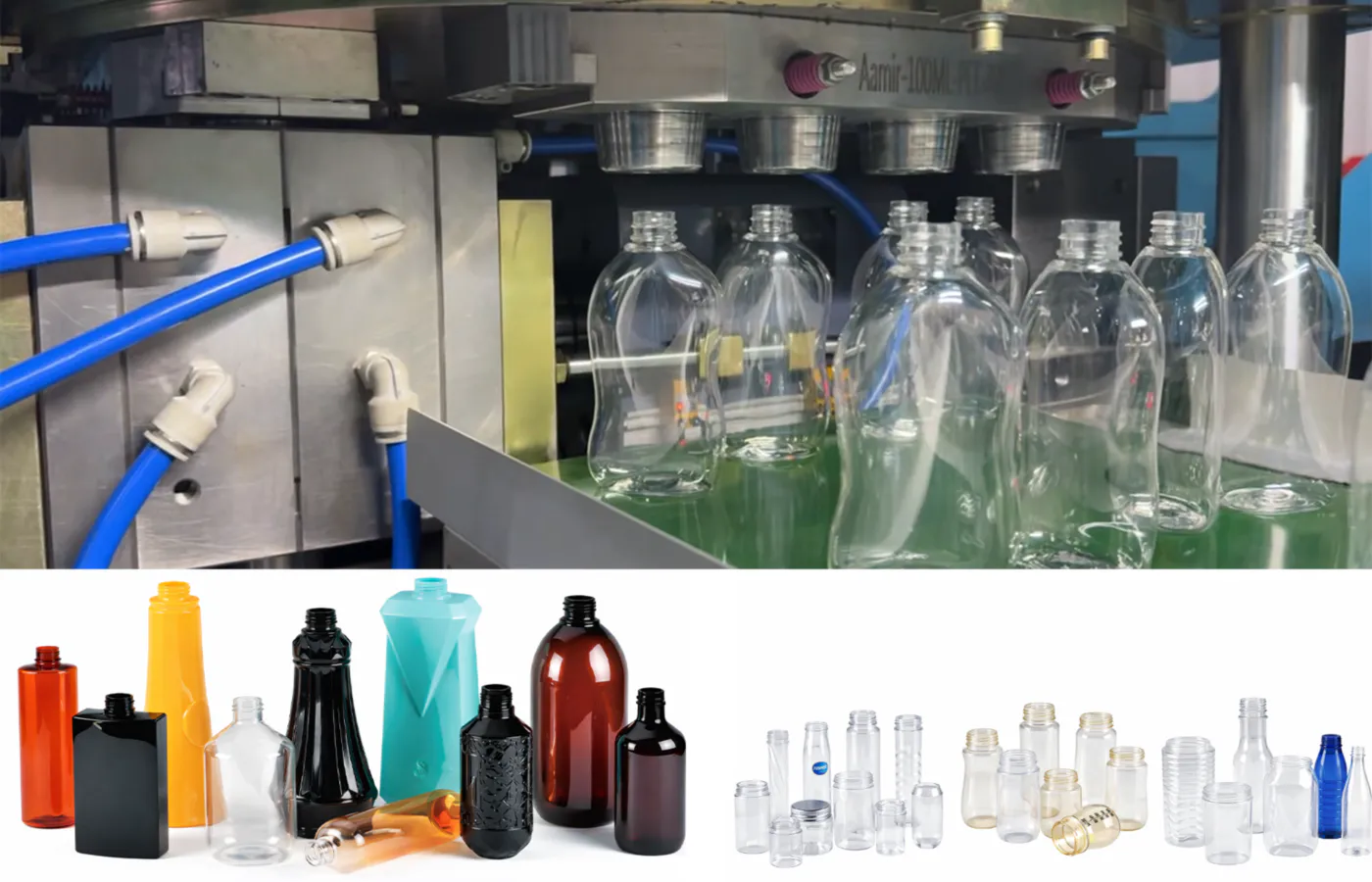
The injection stretch blow moulding machine supports rapid mould changeovers between different container formats, allowing production of multiple SKUs on a single machine with different cavity tooling sets. Container volumes range from as small as 20 mL for pharmaceutical dropper bottles up to 20 litres for large water containers on appropriate machine models. The same machine platform handles round, oval, square, and complex geometric shapes including special-shaped and craft containers that are difficult to produce with extrusion blow or two-step reheat-stretch blow processes. This format flexibility allows small and medium container manufacturers in Colombia to serve multiple sectors from a single capital investment rather than purchasing dedicated machines for each product category.
Contamination Elimination for Sensitive Product Categories
The closed-loop transfer between injection and blow moulding stations eliminates the preform handling, transport, storage, and re-sorting operations that expose two-step preforms to airborne contamination, moisture absorption, dust deposition, and physical damage. This contamination risk elimination is foundational for pharmaceutical container production where regulatory requirements mandate container integrity, and for baby product applications where parental confidence in material safety is commercially essential. Fully electric EV models additionally eliminate hydraulic oil from the machine environment, preventing any possibility of oil mist contamination of container interiors — a non-negotiable requirement for food-grade and medical-grade container certification under INVIMA and equivalent international regulatory frameworks.
4. Global Demand by Sector: Which Industries Are the Largest Buyers?
Quantifying ISBM machine demand by sector requires synthesizing procurement data from multiple sources, but consistent patterns emerge across global markets including Colombia and broader Latin American industrial regions.
Cosmetics and Personal Care
The cosmetics industry consistently ranks as the largest single buyer of injection stretch blow molding machines globally, driven by the sector’s demanding requirements for visual clarity, precise neck dimensions for pump and dropper fitment, and the ability to produce complex bottle geometries that differentiate premium brands. Colombia’s growing cosmetics export sector — shipping formulated products throughout Latin America — drives steady domestic demand for ISBM investment. Typical bottles include serum droppers, lotion pumps, shampoo containers, perfume bottles, and lip gloss tubes in materials including PET, PETG, PP, and PC, with container weights ranging from two grams to one hundred fifty grams.
Pharmaceutical and Medical Packaging
Pharmaceutical packaging represents the most technically demanding application sector for injection stretch blow moulding machines, with requirements including material compliance with USP, EP, or equivalent pharmacopoeia standards; container dimensional tolerances within hundredths of a millimeter for automated filling equipment compatibility; and process traceability documentation satisfying regulatory audit requirements. Colombia’s pharmaceutical distribution network servicing Andean and Pacific markets creates consistent demand for medical dropper bottles, tablet containers, syrup bottles, and ophthalmic solution packaging in PET, PP, and PPSU materials.
Food and Beverage Industry
Beverage manufacturers — particularly those producing premium waters, juices, edible oils, and specialty drinks — invest in injection stretch blow molding machines for the superior wall thickness uniformity and oxygen barrier performance of one-step produced PET containers compared to two-step alternatives. Wide-mouth food containers in PETG and PP serve jams, sauces, honey, and dry food segments. The food sector’s preference for this technology is reinforced by the contamination-free production environment, which simplifies compliance with INVIMA food safety regulations for container materials in contact with consumable products.
Baby Products and Juvenile Care
Baby bottle manufacturing represents a high-value niche that strongly favors fully electric injection stretch blow moulding machine configurations. Products include feeding bottles, sippy cups, breast pump bottles, and formula storage containers in PPSU, PC, Tritan, and PP — all requiring BPA-free material certification, sterilization resistance at one hundred twenty degrees Celsius, and surface clarity sufficient for parents to monitor fill levels during feeding. The safety-sensitive nature of this category drives premium pricing that justifies the higher machine investment of EV configurations, and Colombia’s growing middle-class family consumer segment creates sustained domestic demand.
Household Cleaning and Agrochemicals
Cleaning product manufacturers producing laundry detergents, fabric softeners, surface cleaners, and personal hygiene products in HDPE-compatible PET containers represent a growing ISBM market segment. Colombian household product brands competing for modern trade retail shelf space increasingly adopt ISBM containers for the superior visual quality and shelf-presence differentiation they offer over extrusion blow moulded equivalents. Agrochemical packaging in chemical-resistant materials serves Colombia’s agricultural sector with containers for herbicides, pesticides, and foliar fertilizers that require both barrier properties and precise neck geometry for child-resistant closure systems.
5. Working Principle of the One-Step Injection Stretch Blow Moulding Machine
The injection stretch blow molding process executes four sequential operations on the same preform, with the rotary indexing table advancing preforms through each station in a synchronized cycle. The process cycle begins at the injection station where precisely metered polymer melt — prepared by a reciprocating screw plasticizing unit — is injected under high pressure into a closed multi-cavity injection mould. The injection mould’s hot runner system distributes melt evenly to all cavities, and the mould temperature control system maintains precise wall temperatures that govern crystallization kinetics for the specific material being processed. After a controlled cooling period, the injection mould opens while the blow mould remains closed, and the rotary table advances preforms to the temperature conditioning station.
At Station 2, the preform temperature profile is adjusted through a brief conditioning period using the retained injection heat supplemented by controlled heating or cooling to achieve the specific temperature gradient — typically warmer in the body zone and cooler at the neck — that enables optimal biaxial orientation during subsequent stretch blowing. Some machine configurations perform preform tail cutting at this station to remove the injection gate vestige before blowing. The turntable then advances conditioned preforms to the stretch blow station, where a core rod stretches the preform longitudinally to the designed stretch ratio while high-pressure blow air simultaneously expands the container radially. This simultaneous biaxial stretching under controlled conditions aligns polymer chains in both the axial and hoop directions, producing the improved mechanical properties, optical clarity, and barrier performance characteristic of one-step injection stretch blow moulding machine output. The finished container is released at Station 4 and ejected via gravity drop or mechanical take-out arm to a conveyor or collection chute.
Technical Specifications Comparison Table — Representative Machine Models
| Parameter | HGY50-V3-EV (3-Station) | HGY150-V4 (4-Station) | HGY200-V4 (4-Station) | HGY250-V4 (4-Station) | HGY650-V4 (Large) |
|---|---|---|---|---|---|
| Screw Diameter (mm) | 40 / 50 / 55 | 40 / 50 / 55 / 60 | 40 / 50 / 55 / 60 | 50 / 55 / 60 | 50 / 55 / 60 |
| Theoretical Injection Volume (cm³) | 239 / 315 / 442 | 188 / 310 / 380 / 480 | 188 / 310 / 380 / 480 | 340 / 420 / 480 | 340 / 420 / 480 |
| Injection Clamping Force (kN) | 50 | 150 | 300 | 300 | 400 |
| Blowing Clamping Force (kN, single side) | 100 | 200 | 200 | 200 | 400 |
| Motor Power (kW) | 34.8 | 43.2 | 49.2 | 67.7 | 75.7 |
| Heating Power (kW) | 10.4 | 10 | 10 | 15 | 15 |
| Blow Air Pressure (MPa) | 2.0–3.5 | 2.0–3.5 | 2.0–3.5 | 2.0–3.5 | 2.0–3.5 |
| Cooling Water Pressure (MPa) | 0.4–0.6 | 0.4–0.6 | 0.4–0.6 | 0.4–0.6 | 0.4–0.6 |
| Voltage (V) | 370–400 | 370–400 | 370–400 | 370–400 | 370–400 |
| Machine Dimensions L×W×H (mm) | 3800×1200×2500 | 4200×1400×2900 | 4800×2000×3200 | 6300×2400×3700 | 6100×2600×4200 |
| Machine Weight (T) | 3.5 | 6 | 13 | 16 | 28 |
| Max. Container Volume | 2500 mL | 2500 mL | 2500 mL | 2500 mL | 20 L |
6. Environmental Grade, Operating Conditions, Typical Failure Modes, and Recommended Configuration
Environmental Grade: Injection stretch blow moulding machines are designed for indoor factory environments with controlled temperature ranges of fifteen to forty degrees Celsius and relative humidity not exceeding eighty-five percent non-condensing. The mould zone requires clean, dry compressed air free from oil mist and particulates to maintain container interior cleanliness standards — a critical parameter for pharmaceutical and food-grade applications. Colombian production environments in tropical coastal regions require attention to humidity control in compressor air preparation systems, as moisture in blow air causes surface defects and can compromise sterility requirements.
Operating Conditions: The injection stretch blow moulding machine operates at elevated temperatures throughout the barrel and hot runner system, typically one hundred seventy to three hundred degrees Celsius depending on the material being processed. The injection unit experiences cyclic hydraulic or servo loading at frequencies of one to four cycles per minute, with peak injection pressures reaching one hundred fifty to two hundred fifty megapascals at the injection screw face. The blow station experiences rapid pressurization and depressurization cycles at two to three and a half megapascals that impose fatigue loading on blow mould components, core rod seals, and blow air valve assemblies. Continuous operation in a production environment involves thermal cycling of mould components that demands appropriate mould steel selection and surface treatment to prevent premature wear or dimensional drift.
Typical Failure Modes: Based on operational experience across installed ISBM machine fleets, the most common failure modes include hot runner valve gate wear causing streaking or non-fill defects in injection cavities; stretch rod seal degradation leading to inconsistent stretch ratios and uneven wall thickness distribution; blow mould cavity corrosion from condensation in high-humidity environments affecting surface finish of the container exterior; temperature zone control sensor drift causing processing temperature deviations that affect material crystallinity; and servo motor encoder feedback errors in fully electric models causing position repeatability issues that manifest as dimensional variation between cycles. Preventive maintenance programs addressing these failure vectors typically achieve mean time between failures exceeding six thousand operating hours for properly maintained machines.
Recommended Configuration by Industry: Cosmetics and food-grade container production benefits from the HGYS150-V4 or HGYS200-V4 servo-hydraulic configurations that balance energy efficiency with high cavity-count flexibility. Pharmaceutical container production should specify the fully electric EV series (HGY150-V4-EV or HGY150-V4-EV equivalent) to eliminate oil contamination risk. Baby product manufacturers require EV configurations with material-specific processing capabilities for PPSU and Tritan. Large-container producers for water and agricultural applications should evaluate the HGY650-V4 four-station platform that handles containers up to twenty litres with 400 kN clamping force. For Colombian manufacturers entering ISBM production for the first time, the compact HGY50-V3-EV three-station fully electric model provides a low capital entry point with full process capability across PET and PETG materials.
7. Regulatory Framework for ISBM-Produced Containers by Market
Colombia: Container manufacturers producing food-contact, pharmaceutical, or cosmetic packaging in Colombia operate under INVIMA (Instituto Nacional de Vigilancia de Medicamentos y Alimentos) oversight. Decree 3075/1997 and its successors govern food safety requirements for packaging materials, requiring that container materials not migrate harmful substances into food products. INVIMA Resolution 3131/1998 addresses cosmetic product regulations including packaging material requirements. Pharmaceutical containers must comply with the Colombian Pharmacopoeia and corresponding Farmacopea Internacional standards for container-closure integrity and extractables testing.
European Union: EU Regulation 10/2011 on plastic materials and articles intended for food contact establishes the positive list of authorized monomers, additives, and polymer production aids relevant to PET, PP, PC, and other ISBM-processed materials. EU Regulation 2023/2055 updated migration limits for specific substances. EU GMP regulations for pharmaceutical packaging (Annex 1 of EU GMP Guidelines) govern pharmaceutical container production environments and process validation requirements relevant to ISBM production of pharmaceutical primary packaging.
United States: FDA CFR 21 Part 177 governs indirect food additives for polymers used in food packaging, including PET (177.1630), PP (177.1520), and PC (177.1580). For pharmaceutical containers, USP Chapter 661 (Plastic Packaging Systems and Their Materials of Construction) and Chapter 1664 (Assessment of Drug Product Leachables Associated with Pharmaceutical Primary Packaging/Delivery Systems) define testing requirements that ISBM-produced pharmaceutical containers must satisfy. FDA 21 CFR Part 211 covers Current Good Manufacturing Practice regulations applicable to pharmaceutical container production environments.
8. About Our ISBM Machine Manufacturing Expertise
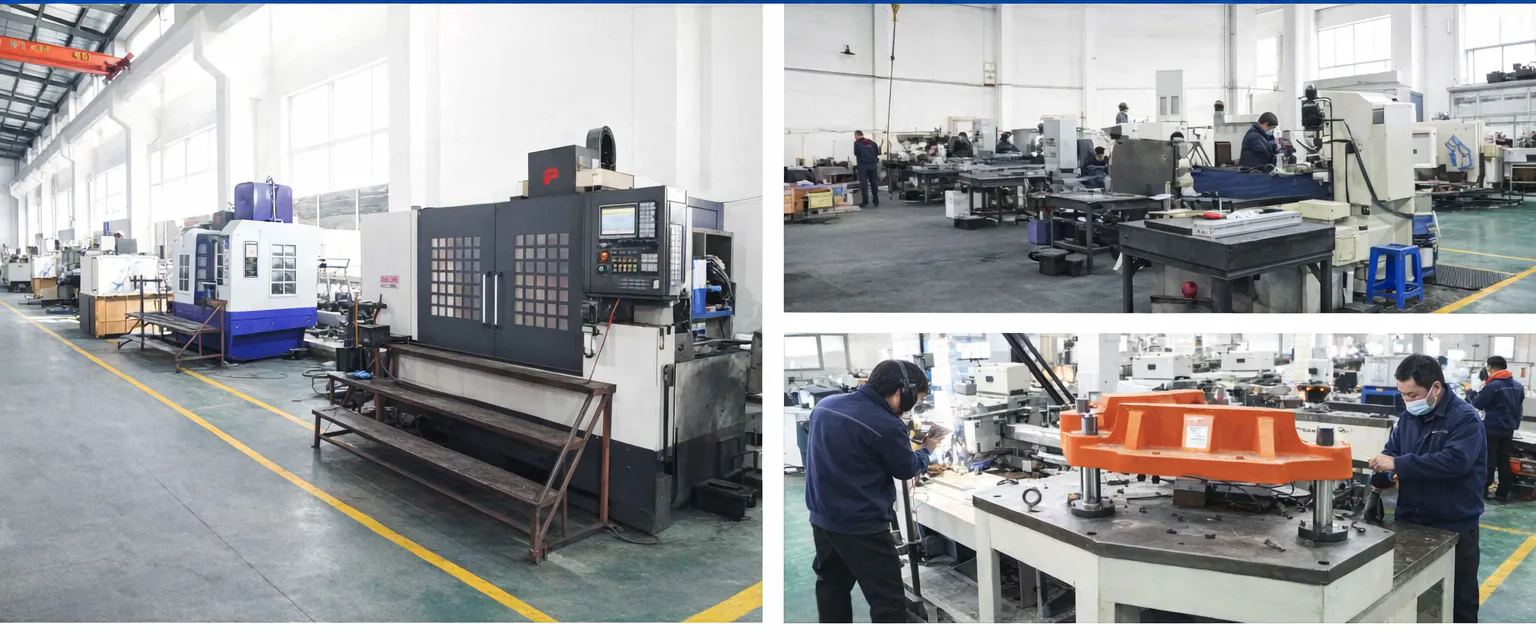
Our engineering team of more than twenty-five specialists covers mechanical design, hydraulic and servo systems, control software, mould engineering, and application process optimization — providing customers with technical support that extends from initial container design consultation through production commissioning and ongoing process improvement.
The machine series spans configurations from compact three-station fully electric units suitable for specialty container production to large four-station platforms handling twenty-litre containers with up to twenty-eight cavities per shot. Compatibility with ASB and Aoki mould formats allows customers transitioning from existing platforms to leverage existing tooling investments while gaining the energy efficiency, precision, and support infrastructure of current-generation machines.
WorkShop
Frequently Asked Questions About ISBM Machines
Editor: PXY